During the European Research and Innovation Days (22-24 September 2020), high-level independent experts presented their proposals to the European Commission for possible EU missions on some of the most pressing societal challenges we are facing. Among them, making Europe climate resilient, restoring our ocean and waters, achieving 100 climate-neutral cities, and ensuring 75% of soils are healthy.
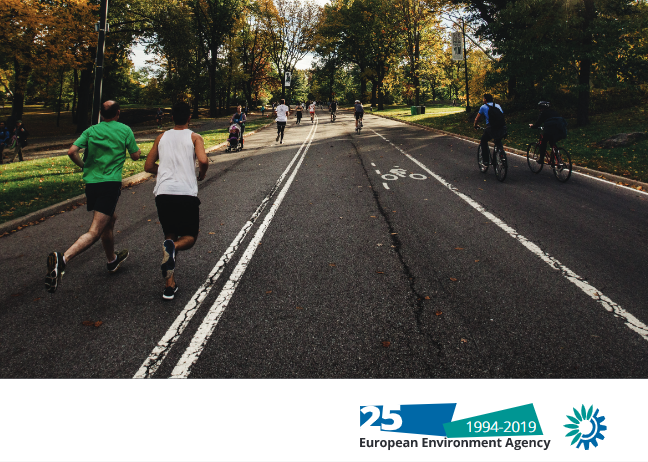
The EEA has just released a new report: “Healthy environment, healthy lives: how the environment influences health and wellbeing in Europe”. A significant proportion of the burden of disease in Europe continues to be attributed to environmental pollution resulting from human activity. This report analyses the links existing between the quality of Europe’s environment and our health and well-being.
Read the Full Report here
The Sustainable Future Policy Lab is a commentary site built by leading authors in environmental economics which focuses on environmental, natural resource and climate change economics and is aimed at academics, the public, policymakers and journalists. It includes articles from SFPLab members and strongly encourage submissions from external contributors. External contributions are reviewed by internal editors before publication.
All contributions are based on the latest research results and grounded in environmental economics theory and practise. The SFPLab’s aims are (1) to highlight current academic research from the SFPLab team; (2) to provide a rapid response to current events providing expertise and background information that may get overlooked by the mainstream media; and (3) to provide policy advice to governments, institutions and NGOs on different aspects of the environmental and climate debate. All articles are attributed to one of the editorial team.
The website includes four types of contributions: Analyses are research-based articles on policy-relevant issues related to sustainability and environmental issues. Opinions are research-based discussions that, in addition to analysing current policy-relevant issues, also contain the personal opinion of the researcher. The News section contains policy-relevant contributions of SFPLab members in other non-academic outlets and not contributed solely to SFPLab. Publications gives an overview of the recent academic publications of the SFPLab containing a brief yet policy-relevant summary.
The paper “Climate economics support for theUN climate targets” by Martin C. Hänsel, Moritz A. Drupp, Daniel J. A. Johansson, Frikk Nesje, Christian Azar, Mark C. Freeman, Ben Groom & Thomas Sterner has just been published on Nature Climate Change
Abstract
Under the UN Paris Agreement, countries committed to limiting global warming to well below 2 °C and to actively pursue a 1.5 °C limit. Yet, according to the 2018 Economics Nobel laureate William Nordhaus, these targets are economically suboptimal or unattainable and the world community should aim for 3.5 °C in 2100 instead. Here, we show that the UN climate targets may be optimal even in the Dynamic Integrated Climate–Economy (DICE) integrated assessment model, when appropriately updated. Changes to DICE include more accurate calibration of the carbon cycle and energy balance model, and updated climate damage estimates. To determine economically ‘optimal’ climate policy paths, we use the range of expert views on the ethics of intergenerational welfare. When updates from climate science and economics are considered jointly, we find that around three-quarters (or one-third) of expert views on intergenerational welfare translate into economically optimal climate policy paths that are consistent with the 2 °C (or 1.5 °C) target.
The pandemic is posing serious challenges to all our lives and research is inevitably affected with lots of events cancelled or postponed. This obviously applies also to our LIFE DICET project in 2020. But on May 7, 2020 our LIFE project won its bet over the difficulties due to COVID-19. It was just a tiny little battle in a much bigger war against the virus, just one game in a long playoff series, by just one point in a close game. But still a meaningful victory.
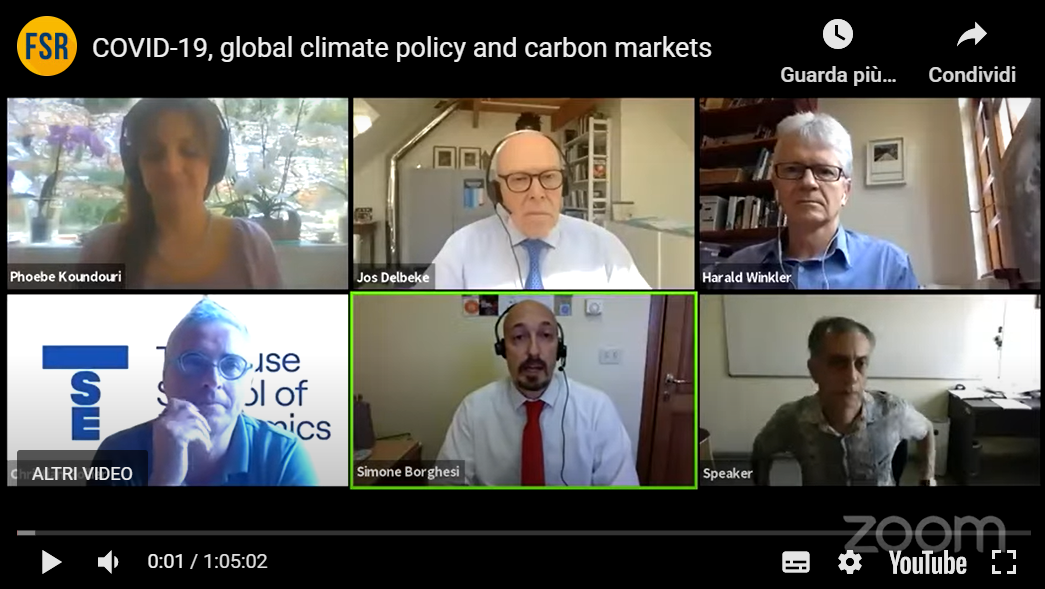
The victory of the Policy Outreach Committee of EAERE and FSR Climate was that of managing to organize in short time an online event on “COVID-19, global climate policy and carbon markets” which could replace the workshop that was originally planned for the State of the Union here in Florence. And the event turned out to be very successful both in terms of numbers of participants (388 attending the events and many visualizations on Youtube) and quality of the interventions. Each speaker enriched the debate with his/her own views bringing heterogeneous perspectives from all over the world and from different economic contexts.
As any memorable victory, there are backstage stories to tell. In this case, at least two of them (before and after the event) are worth mentioning.
Before the beginning of the live event we had to solve some technical issues which were complicated by the need to keep physical distance with my team members. As the problem could not be solved, I eventually had to run to another computer just two minutes before the live event started. No more time for thinking: sit down and go….I share with some of my team members an insane passion for basket and one of them wrote me: “That was a buzzer beater from your side, you entered the webinar cold as ice!”. I was actually melting for the running and the tension of not knowing how to solve the technical problem till the very end, but good that everything was successful in the end.
But the best part of the backstage stories came after the event. I was trapped in a long series of online meetings the whole afternoon. When I finally finished, I found lots of email exchanges among the speakers who continued to discuss, exchange documents and ideas until late at night. I found this simply amazing. It made my day to see how deeply involved all of them are in discussing possible solutions. This capability of provoking ideas and further debates is what makes an event really successful. It is particularly meaningful, in my view, because it shows the capacity of our LIFE project and of enthusiasm for research to win over the difficulties and deliver its results.
The fight versus COVID19 is a hard one and a long way is still to go. Some of us lost friends and relatives in this fight. But we know we can win if we stay distant but united. Well, our event was a little, still important, example of what we can do as a research community keeping distant but united.
1. COVID19 AND RECESSION’S IMPACT ON EU CLIMATE AND ENERGY POLICY
A major energy transition is under way, shaped by political will to tackle climate change and minimise its negative impacts. Policies have been defined under the Paris Agreement and geared to a number of targets. The EU has decided to reduce its greenhouse gas emissions by 2030 by at least 40% compared to 1990, and has agreed to continue the path towards climate neutrality by 2050. The present and seemingly inevitable recession following the Covid-19 crisis is drastically reducing energy consumption and greenhouse gas emissions. The extent to which this will help towards achieving the 2030 target depends on how long and how deep the recession will be.
2. THE NEW ROLE OF FLEXIBLE WORKING AND AIR TRAVEL
However, the sudden decline in greenhouse gas emissions is the opposite of what a meaningful response to climate change should be, both in terms of living conditions and economic efficiency. The challenge is to structurally decouple economic growth from emissions, not to have them both going down. The lock-down may have some lasting effect in changing some of our habits. For example, general familiarity with telework will perhaps lead to a more permanent increase in flexible working arrangements and reduce transport movements and traffic congestion. One can also expect a more general reflection on whether all business and leisure travel, not least by air, is a necessity. Nevertheless, such changes may not be as extensive and lasting as some observers think. For this reason, it is important to implement an appropriate package of post Covid19 economic and climate policies to ensure that emissions do not grow again when the economy will eventually recover from the pandemics. In all circumstances, it is crucial that the targets set in the context of the EU energy and climate policies be maintained. The emissions profile of a “BAU” or “existing policies” scenario may however need updating.
3. CARBON PRICES: A DANGEROUS FALL
A key indicator for the European Green Deal is the price of EU allowances, a carbon price that serves as a key indicator worldwide. As could and should be expected, carbon prices have fallen recently reflecting reduced demand for allowances in line with the drop in power and industrial production. This temporary drop from the €25 to a €15-20 range, acts as an important automatic stabilizer for businesses in distress. A repetition of the experience of a sharp fall in the price of EU ETS allowances after the 2008 recession and a long period of very low carbon price levels should be avoided. There are two reasons to believe that this could happen. Firstly, the EU ETS now has a Market Stability Reserve (MSR) that absorbs a potential oversupply in the market in the short- and medium-term. Secondly, market expectations are mostly shaped by the long-term, which is the 2050 carbon neutrality objective, and the likelihood of an upward revision of the target for 2030. Carbon market participants, as well as those developing innovative clean technologies and products of the future, expect in the long-term significantly higher carbon prices. This expectation should be confirmed by a consistent behaviour of the Member States together with the EU institutions.
4. MARKET STABILITY RESERVE & ALLOWANCES
The Market Stability Reserve (MSR) started to operate last year. If the allowances market is “long” beyond a threshold set in legislation (833 million tonnes, which is approx. 50% of ETS emissions in 2018), the MSR intervenes by withdrawing allowances equal to a percentage (24% up to 2023, 12% thereafter) of the excess. At the end of 2018, the allowance market was 1.65 billion tonnes “long” and, therefore, the supply of allowances for the period 1 September 2019 to 31 August 2020 has been reduced by 397 million tonnes (these allowances are placed in the MSR). Some question whether the MSR, with its delayed adjustment mechanism, will be sufficient to avoid a sharp fall in the allowance price. In fact, any reduction in the supply of allowances through the MSR for the period September 2020 – August 2021 will still be based on the excess supply of allowances in 2019, i.e. before the current crisis started. In case the MSR is unable to absorb the surplus, the EU Commission should propose changes in the planned review of the ETS in 2021.
5. REVISED TARGETS FOR GAS EMISSION REDUCTION
In its European Green Deal, the Commission already indicated its intention to increase the 2030 greenhouse gas emission reduction target from 40% to 50%, or even 55% (with respect to 1990 levels). Today the ETS sectors face a mandatory emission reduction of 43% by 2030 compared to 2005, and revised targets will likely increase that obligation by at least another 10 or 15%. Such a reduction in the supply of allowances would likely push their prices up, or at least reduce the extent of their decline, in the face of lower demand due to the economic downturn. Another major question is about the other half of Europe’s emissions, namely those not covered by the ETS, in particular the sectors of transport and buildings. The pricing of these emissions can be much improved through the planned review of the EU’s energy tax directive. This offers a major opportunity to remove the all too generous exemptions, such as on maritime and aviation fuels, or by adding a CO2 element to the harmonized minimum tax rates.
6. CHANNELING ECONOMIC AIDS INTO SUSTAINABLE GOALS
The current health crisis and the likely economic downturn should be seen as an unsolicited – and much regrettable – opportunity. That is, the massive influx of liquidity in the system to support the economies could be subject, wherever possible, to conditionality so that the “new start” will be already oriented towards a carbon-neutral future. The difficult agreement reached in the Eurogroup on 9 April recognises this under point 21: “Work is ongoing on a broader Roadmap and an Action Plan to support the recovery of the European economy through high quality job creation and reforms to strengthen resilience and competitiveness, in line with a sustainable growth strategy”. This good intent now needs to be put into practice.
7. INVESTMENT STIMULUS PACKAGE
A major investment stimulus package is going to be needed to overcome the recession caused by Covid-19. The Commission’s impact assessments on climate and energy policy serve as useful guidance on where a major surge in investments is needed. We know that energy efficiency requires a major push in the construction sector, both for new buildings and renovations in social housing, hospitals and schools. We know that the energy transition requires more investments in renewable energy, digitised grid infrastructure, and energy storage. The significantly reduced electricity demand of today indicates that much more attention should go towards managing flexibility in real-time instead of increasing base-load capacity. In transport, electrification is on its way, but investment in charging facilities, traffic management, clean public transport and long-distance rail needs to be ramped up. In industry, not least in power generation and carbon intensive industrial sectors, major efforts are being undertaken to develop new technologies based on hydrogen and carbon capture, use and storage, for example. Such investments can create the jobs we need in the post-Covid-19 era, and allow to realise the European Green Deal objectives at the same time.
In industry, not least in power generation and carbon intensive industrial sectors, major efforts are being undertaken to develop new technologies based on hydrogen and carbon capture, use and storage, for example. Such investments can create the jobs we need in the post-Covid-19 era, and allow to realise the European Green Deal objectives at the same time.
8. TRADE AND BORDER ADJUSTMENTS
Since the ETS may imply a loss of competitiveness for European industries vis-à-vis competitors located in countries where no similar burden is imposed, a border adjustment has been proposed, which would imply both a levy on imports and possibly a rebate on exports. While it is clear that different tax or quasi-tax treatments imply a distortion of trade, and a growing one if the ETS carbon price continues rising as planned, such mechanisms are not easy to implement and are subject to criticism both on analytical and political grounds. Therefore, it is of crucial importance to realise that a WTO-compatible border adjustment mechanism will take a long time before it can be implemented. Meanwhile, at least equal attention needs to go to domestic policy reinforcement, such as support for innovation and a less rigid interpretation of the State aid rules.
9. FOSSIL FUELS: A COMEBACK
The recent fall in the prices of fossil fuels is upsetting the incentives that should support a transition towards sustainability, and this will last for a period of uncertain duration. A reference criterion for business decisions has been lost and the consequence may be a paralysis, or even a “comeback” of fossil fuels, mothballing or abandonment of investment in renewables. Bankruptcies in the energy industry may imply loss of valuable investment. Consequently, the business case of the green transition may appear to be weakened in the near-term, but a clear policy response, in particular on carbon pricing, may be politically more acceptable because of the price drop in fossil fuels.
10. CORRECTING OIL AND GAS PRICES
The agreement reached by oil producing countries on Easter Sunday to reduce global output by 10% has already been labeled by many commentators as insufficient to counteract the fall in demand and therefore sustain oil prices, even at the already low pre-crisis levels. So, the EU should better prepare for a longer period of low oil and gas prices, and seize the opportunities these can offer. Policies to stabilize fossil fuel prices, which are usually considered to be in the interest of producing companies and countries at the expense of consumers, may prove to be positive if wisely designed and managed, and, most importantly, limited in time to the current crisis situation. In particular, prices of fossil fuels could be stabilised at the pre-Covid levels via temporary taxes, whose revenue could help finance the various income-support policies adopted and/or acceleration of investment projects for sustainability.
Read (and listen) more on post Covid19 energy and climate policies and scenarios in our Covid19- dedicated content:
A paper by Christian Gollier et Olivier Gossner published on Covid Economics,vol. 1, n. 2, April 2020, pp. 32–42.
Abstract
It is well-known that group testing is an efficient strategy to screen for the presence of a virus. It consists in pooling n individual samples with a single test using RT-PCR. If at least one individual is infected, the test is positive, and it is negative otherwise. We show how group testing can be optimized in three applications to multiply the efficiency of tests against Covid-19 : Estimating virus prevalence to measure the evolution of the pandemic; bringing negative groups back to work to exit the current lockdown; and testing for individual infectious status to treat sick people. For an infection level around 2%, group testing could multiply the power of testing by a factor 20. The implementation of this strategy in the short run requires limited investments and could bypass the current immense shortage of testing capacity.
The COVID-19 pandemic is having a dramatic impact on economic activities worldwide. This has both direct and indirect effects on greenhouse gas emissions and global warming. On the one hand, the current pandemic has a direct and immediate effect on emissions since the fall in production and traffic volumes drastically reduces emissions, as it has already been observed after a few weeks of lockdown in a growing number of countries. On the other hand, COVID-19 might have multiple indirect effects on emissions which could run in the opposite direction, especially in the medium-long run. In the first place, the deep economic recession which might affect the world economy in the next years is likely to slow down the technological progress that is needed to progress along a low-carbon economic path. In the second place, the economic recession obviously has a large impact also on carbon markets: the fall in production brings about a sharp decrease in the demand of emission allowances, which causes a reduction in the allowance prices, and thus also in the incentive to invest in cleaner technologies. Finally, the health emergency may hinder international negotiations on emissions reduction and on the rulebook for international emissions trading to be agreed under the climate pact, as clearly emerges from the recent decision to postpone COP26 to 2021. All these indirect, negative consequences of COVID-19 on emissions reduction might well overtake in the long run its direct, short run effects on emissions.
In any case, COVID-19 has already diverted attention from the climate emergency to the much more urgent health emergency. This is certainly logical, legitimate and partially unavoidable given the present extraordinary circumstances. But we should bear in mind that climate change was estimated to cause about 150 thousand deaths in 2000 by the World Health Organisation (the same organization we now correctly rely on for estimates on COVID-19). The WHO (2014) warned us that this number is expected to raise to 250 thousands per year between 2030 and 2050 if appropriate measures will not be taken. As Phoebe Koundouri recently wrote, climate change has the potential to cause more deaths than COVID-19 but its consequences are generally perceived as only long-run problems (though its effects are visible also in the present) since they are spread over time.
While all our efforts are now reasonably devoted to finding a way out of the health emergency, we should also start thinking about the future economic and climate policy packages that will be needed once the health crisis will be over (hopefully soon). It will be important to be ready when the pandemic will be gone. Any crisis brings also an opportunity to re-think the existing paradigm. As Kåberger and Sterner have pointed out, the present crisis brings the opportunity to carry out a Schumpeterian process of creative destruction that restructures our economies towards a more sustainable path. If we will focus exclusively on spurring the economy, no matter whom gets the countries’ subsidies, no matter how polluting subsidized firms can be, then this opportunity will be lost. And I don’t think we can afford to miss this opportunity if we are to avoid a new peak in emissions in the future. In this regard, we should learn from the recent past: in 2009 the financial crisis caused CO2 emissions to fall by 1,44%, but the following year emissions increased by 5,13% (much more than before the crisis) as a consequence of the policy measures that were taken to push the economies.
For these reasons, it appears particularly important to identify in advance a suitable economic-climate package which may relaunch clean investments when economic activities will resume and avoid a sharp growth in emissions when the pandemic will be gone.
As in any crisis, there are lessons to be learnt. One lesson is that international cooperation is crucial to face global threatens. We knew we are all on the same ship but now is much more evident than ever. In a globalized world the problems of “the others” end up being our own problems, whether we like it or not. It applies to COVID-19, as much as to global warming. In this sense, by promoting international cooperation among different jurisdictions on climate policy in general and on Emission Trading Systems in particular, I believe the LIFE DICET project is more important than ever.
All ETSs are now under pressure because of low allowances demand. This creates a further opportunity to exchange information and learn from each other on how to deal with this common threat. In this regard, differently from the past, the EU ETS is now fortunately sheltered by the presence of the Market Stability Reserve (MSR). But the MSR is currently designed to adjust supply with a two-years lag, thus not offsetting any demand shock, however significant, that occurs within this time. This lag might prove crucial in case of a COVID-induced economic downturn. Therefore, one might reconsider the introduction of a price floor as in other ETSs. As suggested by Flachsland et al. (2020), a price floor could be used as a complementary policy to the MSR, as a further safeguard against unexpectedly low prices and unforeseeable circumstances like the ones we are going through.
The climate crisis, as the current global health crisis, gives us no other choice but exchanging information, learning from each other and cooperating to find solutions. Both the climate crisis and the health crisis will be very challenging fights, but we’ll either win them acting all together or lose them all together. My wish is that the current difficult experience may reinforce this awareness and that international cooperation in climate policies may not only survive but actually be reinforced and even extended after the pandemic.
References
Flachsland, C., Pahle, M., Burtraw, D., Edenhofer, O., Elkerbout, M., Fischer, C., Tietjen, O. and Zetterberg, L., (2020). How to avoid history repeating itself: the case for an EU Emissions Trading System (EU ETS) price floor, Climate Policy, 20 (1), 133-142.
World Health Organization (2014). Quantitative risk assessment of the effects of climate change on selected causes of death, 2030s and 2050s. WHO Press, World Health Organization, Geneva, Switzerland.
The International Renewable Energy Agency (IRENA) produces comprehensive statistics on a range of topics related to renewable energy. This publication presents renewable power generation capacity statistics for the past decade (2010-2019) in trilingual tables.
Renewable power generation capacity is measured as the maximum net generating capacity of power plants and other installations that use renewable energy sources to produce electricity. For most countries and technologies, the data reflects the capacity installed and connected at the end of the calendar year. Data has been obtained from a variety of sources, including an IRENA questionnaire, official national statistics, industry association reports, other reports and news articles.
Download & read the Statistics here Source: IRENA’s website
Opinion piece by Professor Phoebe Koundouri – EAERE President-elect, Athens University of Economics and Business, UN SDSN-Greece, EIT Climate KIC Hub Greece.
We use cookies on our website to give you the most relevant experience by remembering your preferences and repeat visits. By clicking “Accept All”, you consent to the use of ALL the cookies. However, you may visit "Cookie Settings" to provide a controlled consent.Privacy Policy
This website uses cookies to improve your experience while you navigate through the website. Out of these, the cookies that are categorized as necessary are stored on your browser as they are essential for the working of basic functionalities of the website. We also use third-party cookies that help us analyze and understand how you use this website. These cookies will be stored in your browser only with your consent. You also have the option to opt-out of these cookies. But opting out of some of these cookies may affect your browsing experience.
Necessary cookies are absolutely essential for the website to function properly. These cookies ensure basic functionalities and security features of the website, anonymously.
Cookie
Duration
Description
cookielawinfo-checkbox-advertisement
1 year
Set by the GDPR Cookie Consent plugin, this cookie is used to record the user consent for the cookies in the "Advertisement" category .
cookielawinfo-checkbox-analytics
11 months
This cookie is set by GDPR Cookie Consent plugin. The cookie is used to store the user consent for the cookies in the category "Analytics".
cookielawinfo-checkbox-functional
11 months
The cookie is set by GDPR cookie consent to record the user consent for the cookies in the category "Functional".
cookielawinfo-checkbox-necessary
11 months
This cookie is set by GDPR Cookie Consent plugin. The cookies is used to store the user consent for the cookies in the category "Necessary".
cookielawinfo-checkbox-others
11 months
This cookie is set by GDPR Cookie Consent plugin. The cookie is used to store the user consent for the cookies in the category "Other.
cookielawinfo-checkbox-performance
11 months
This cookie is set by GDPR Cookie Consent plugin. The cookie is used to store the user consent for the cookies in the category "Performance".
CookieLawInfoConsent
1 year
Records the default button state of the corresponding category & the status of CCPA. It works only in coordination with the primary cookie.
ts
3 years
PayPal sets this cookie to enable secure transactions through PayPal.
ts_c
3 years
PayPal sets this cookie to make safe payments through PayPal.
viewed_cookie_policy
1 year
The cookie is set by the GDPR Cookie Consent plugin and is used to store whether or not user has consented to the use of cookies. It does not store any personal data.
Functional cookies help to perform certain functionalities like sharing the content of the website on social media platforms, collect feedbacks, and other third-party features.
Cookie
Duration
Description
iutk
5 months 27 days
This cookie is used by Issuu analytic system to gather information regarding visitor activity on Issuu products.
Performance cookies are used to understand and analyze the key performance indexes of the website which helps in delivering a better user experience for the visitors.
Analytical cookies are used to understand how visitors interact with the website. These cookies help provide information on metrics the number of visitors, bounce rate, traffic source, etc.
Cookie
Duration
Description
_ga
2 years
The _ga cookie, installed by Google Analytics, calculates visitor, session and campaign data and also keeps track of site usage for the site's analytics report. The cookie stores information anonymously and assigns a randomly generated number to recognize unique visitors.
_gat_gtag_UA_30338142_1
1 minute
Set by Google to distinguish users.
_gid
1 day
Installed by Google Analytics, _gid cookie stores information on how visitors use a website, while also creating an analytics report of the website's performance. Some of the data that are collected include the number of visitors, their source, and the pages they visit anonymously.
CONSENT
2 years
YouTube sets this cookie via embedded youtube-videos and registers anonymous statistical data.
iutk
5 months 27 days
This cookie is used by Issuu analytic system to gather information regarding visitor activity on Issuu products.
Advertisement cookies are used to provide visitors with relevant ads and marketing campaigns. These cookies track visitors across websites and collect information to provide customized ads.
Cookie
Duration
Description
mc
1 year 1 month
Quantserve sets the mc cookie to anonymously track user behaviour on the website.
VISITOR_INFO1_LIVE
5 months 27 days
A cookie set by YouTube to measure bandwidth that determines whether the user gets the new or old player interface.
YSC
session
YSC cookie is set by Youtube and is used to track the views of embedded videos on Youtube pages.
yt-remote-connected-devices
never
YouTube sets this cookie to store the video preferences of the user using embedded YouTube video.
yt-remote-device-id
never
YouTube sets this cookie to store the video preferences of the user using embedded YouTube video.