Economy & carbon markets

Government of Cyprus to Start Consultation on Green Fiscal Reform

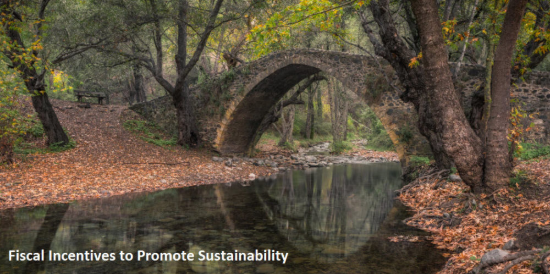
The 20th Global Conference on Environmental Taxation, organised by the Cyprus University of Technology, was held in Cyprus on 26-27 September 2019. GCET is the leading global forum for exchanges on the principles and practice of environmental taxation and other market-based instruments for promoting the transition to low-carbon and resource-efficient societies. The conference started with a talk by the Finance Minister of Cyprus Mr. Harris Georgiades, who declared that the government of Cyprus will open a public consultation in 2020 about the implementation of a green fiscal reform, with the aim to legally adopt this reform from 2021 onwards. Cyprus is among the EU Member states that are not on track to meet their greenhouse gas emission reduction commitments up to 2030. The proposal for a green tax reform, a key part of which is the gradual adoption of a carbon tax on all sectors of the Cypriot economy that are not subject to the EU ETS, is being prepared by the Finance Ministry of Cyprus together with Prof. Theodoros Zachariadis of the Cyprus University of Technology, EAERE’s Country Representative in Cyprus.

READ MORE
Economy & carbon markets

Fiscal Monitor: How to Mitigate Climate Change

The October 2019 edition of the Fiscal Monitor by the International Monetary Fund focuses on the design of fiscal policies for climate mitigation at the domestic and international level.

This report emphasizes the environmental, fiscal, economic, and administrative case for using carbon taxes, or similar pricing schemes such as emission trading systems, to implement climate mitigation strategies. It provides a quantitative framework for understanding their effects and trade-offs with other instruments and applies it to the largest advanced and emerging economies. Alternative approaches, like “feebates” to impose fees on high polluters and give rebates to cleaner energy users, can play an important role when higher energy prices are difficult politically. At the international level, the report calls for a carbon price floor arrangement among large emitters, designed flexibly to accommodate equity considerations and constraints on national policies. The report estimates the consequences of carbon pricing and redistribution of its revenues for inequality across households. Strategies for enhancing the political acceptability of carbon pricing are discussed, along with supporting measures to promote clean technology investments.

Source: IMF

READ MORE
Water, agriculture, forestry

New FAO Digital Report on the State of Food and Agriculture 2019

This report explores the food loss and waste issues. The broad estimate FAO provided in 2011 suggested that around 1/3 or 30 percent of the world’s food was lost or wasted every year. This can be considered a preliminary estimate that raised awareness of the issue.

To provide more clarity on the subject, that figure is in the process of being replaced with two separate SDG indicators, the Food Loss Index and the Food Waste Index. These two indices will allow to measure more precisely how much food is lost in production or in the supply chain, or is wasted by consumers or retailers.

Surf through the platform by FAO

Download the Full Report here

READ MORE
Economy & carbon markets

EEA Report: Paving the way for a circular economy – insights on status and potentials

This new report by the EEA takes stock of the initiatives for creating a circular economy that reduce the use of natural resources and minimise harmful emissions and waste. According to the report, European companies are increasingly adopting circular business models, focused mainly on operational efficiency and reducing waste. Another promising development is to shift from product-based to service-based business models. The largest barriers to a greater uptake of such models appear to be corporate culture, market factors and system complexity.

Read the Full Report

Image © Donnie Rosie on Unsplash

READ MORE
Impacts, risks, adaptations

IPCC Special Report on the Ocean and Cryosphere in a Changing Climate

This new Report by IPCC highlights the urgency of prioritizing timely, ambitious and coordinated action to address unprecedented and enduring changes in the ocean and cryosphere. The report reveals the benefits of ambitious and effective adaptation for sustainable development and, conversely, the escalating costs and risks of delayed action. The ocean and the cryosphere – the frozen parts of the planet – play a critical role for life on Earth. A total of 670 million people in high mountain regions and 680 million people in low-lying coastal zones depend directly on these systems. Four million people live permanently in the Arctic region, and small island developing states are home to 65 million people.

Source: IPCC Press Release

The Report can be downloaded here

READ MORE
Energy

New EEA Report on Adaptation challenges and opportunities for the European energy system

This report studies current and future needs for climate change adaptation and climate resilience in the European energy system. This analysis supports the clean energy transition, which involves a huge expansion of renewable energy sources, many of which are sensitive to climate factors.

The Report clearly states that the European energy system needs to take the climate change effects into consideration in addition to pursuing a clean energy transition.Indeed, despite having some possible good outcomes such as less energy needs for heating, global warming impacts will mostly be negative, and our current system is not ready to adapt to them.

Different European regions may be affected differently, but the assessment recommends countries to consider “the impacts of climate change in the development of national climate and energy plans and long‑term strategies under the EU Energy Union.” 

Read the Full Report

READ MORE
Impacts, risks, adaptations

IPCC’S new Special Report on Climate Change and Land

Today, 8 August 2019, the IPCC has officially presented its latest special report titled “Climate Change and Land” during the press conference held at the World Meteorological Organization premises in Geneva, Switzerland from 10 am CEST. The presentation was co-organized with UN Foundation within the framework of the Geneva Environment Network.

The special report deals with climate change, desertification, land degradation, sustainable land management, food security, and greenhouse gas fluxes in terrestrial ecosystems.

The report was developed under the joint scientific leadership of Working Groups I, II, III and the Task Force on National Greenhouse Gas Inventories, and supported by the WG III TSU.

103 experts from 52 countries were selected as Coordinating Lead Authors and Lead Authors – who worked on each individual chapter – and Review Editors.

The full list of Coordinating Lead Authors, Lead Authors and Review Editors can be found here.

Watch the press conference video

Download the report

READ MORE
Energy

Renewables 2019 Global Status Report

REN21 is an international policy network of experts from governments, inter-governmental organisations, industry associations, NGOs, and science and academia. Every year, REN21 produces its annual flagship publication, the Renewables Global Status Report (GSR). According to the evidence of 2018, solar photovoltaics (PV) and wind are becoming increasingly popular in the power sector, with an increasing number of countries generating more than 20% of their electricity with solar PV and wind. However, current trends show that stronger policy decisions are needed across all sectors of energy end-use to make our energy systems sustainable. Data in this year’s report illustrate that ambitious policy and regulatory frameworks are needed to create favourable and competitive conditions, allowing renewable energy to grow and displace more expensive and carbon-emitting fuels.

Read the Full Report

READ MORE
Impacts, risks, adaptations

New Report: Driving finance today for the climate resilient society of tomorrow

UNEP – Finance Initiative partnered with Climate Finance Advisors to deliver this report to the Global Commission on Adaptation as a contribution to a series of technical background papers on finance for adaptation and resilience supporting the GCA’s inaugural flagship report scheduled for September 2019. The report identifies the main barriers in the financial system to accelerated investment in adaptation-related programmes and projects and proposes six sets of recommendations to unlock the financing of adaptation programmes.

“Climate change is already affecting our economy, our society and our environment and these material impacts will continue to increase even if we manage to hit mitigation targets. It is therefore of paramount importance that adaptation to climate change is considered as important as reducing carbon emissions”.

Read the Full Report

READ MORE
Economy & carbon markets

Women’s Digital Financial Inclusion in Africa

|Source: Bill and Melinda Gates Foundation|

African governments are at the forefront of efforts to harness digital technologies to build more inclusive economies. Double-digit growth in mobile phone ownership in the first half of this decade has triggered a surge of innovative digital tools and services across the continent. However, the benefits of the digital age are not being shared equally. Women—especially those living in poor and marginalized communities—are most likely to be on the wrong side of a persistent digital divide.

This year, the Group of Seven (G7) outlined an agenda to fight inequality. As part of this agenda, the G7 Partnership for Women’s Digital Financial Inclusion in Africa will support African governments, central banks, and financial institutions in their efforts to build more inclusive, sustainable, and responsible digital financial systems, ensuring that 400 million more African adults are financially included—nearly 60 percent of whom are women. Essential to efforts to expand digital financial inclusion to women in Africa are five pillars that fall into three categories: infrastructure, regulation, and planning.

Read online

READ MORE