Economy & carbon markets

New World Bank Report “Fiscal Policies for Development and Climate Action”

This report provides practical insights for an effective design and implementation of fiscal policies for both development and climate action. The report maintains that well-designed environmental tax reforms are especially valuable in developing countries, where they can reduce emissions, increase domestic revenues and generate positive welfare effects. The report
offers policy recommendations for finance decision-makers to increase the mobilization of domestic resources and improve human well-being while enhancing development in spite of one if its main threats: climate change.
Read the Full Report

Picture credits: The World Bank Group – own rielaboration

READ MORE
Cities

Clean mobility: Putting an end to polluting trucks

The Commission has welcomed the first EU standards to reduce pollution from trucks. On 19 February, the European Parliament and the Council reached provisional agreement on a Regulation setting strict CO2 emission standards for trucks, for the first time in the EU. The deal follows the agreement reached in December on new CO2 emission standards for cars and light vans in the EU for the period after 2020. Under the agreement, emissions from new trucks will have to be 30% lower in 2030 compared to the 2019 emissions.

Read the News on the European Commission website

READ MORE
Emissions & mitigation

US Green New Deal – Prof. Barbier’s comments on the plan

In the last month, Rep. Alexandria Ocasio-Cortez, D-N.Y., and Sen. Ed Markey, D-Mass. introduced a resolution in Congress calling for a “Green New Deal”. It calls for massive government spending over the next 10 years to shift the U.S. economy away from polluting industries, embrace green infrastructure and produce 100% of energy from renewables. In the process, the Green New Deal aims to create jobs and boost the economy. Prof. Edward Barbier was the author of the UNEP’s Global Green New Deal, a plan to lift the world economy out of the 2008-9 Great Recession, and was asked to comment on the broad outlines of the plan. For further details, see this post in Business Insider and Prof. Barbier’s article in Nature.

READ MORE
Emissions & mitigation

Towards a climate-neutral Europe: EU invests over €10bn in innovative clean technologies

On 26 February 2019, the European Commission has announced an investment programme worth over €10 billion for low-carbon technologies in several sectors to boost their global competitiveness. The EU innovative climate action has a range of benefits for the health and prosperity of Europeans with a tangible impact on people’s lives – from the creation of local green jobs and growth, to energy-efficient, more economic homes, less polluted air, greener public transport systems in cities, and secure supplies of energy and other resources.

Read the Press Release on the European Commission website

Photo credits: European Commission

READ MORE
Impacts, risks, adaptations

UN Climate talks – Katowice

The UNFCCC COP24 in Katowice, Poland, ended with the adoption of a rulebook to facilitate the implementation of the Paris Agreement across the world. The Paris rulebook will enable the Parties to the Paris Agreement to implement, track and enhance their contributions to fight climate change, in order to meet the Agreement’s long-term goals.

Read the Press Release on the European Commission website (Source)

READ MORE
Impacts, risks, adaptations

Clean Energy for All Europeans

Political agreement was reached by negotiators from the Council, the European Parliament and the European Commission on the conclusion of the Clean Energy for all Europeans package, consisting in new rules for making the EU’s electricity market work better. Measures have been provisionally agreed concluding the political negotiations on the Clean Energy for All Europeans package and representing a major step towards completing the Energy Union and combating climate change. Read the Press Release

READ MORE
Cities

Urban Adaptation Support Tool

The Urban Adaptation Support Tool (UAST) guides European adaptation decision-makers and practitioners in cities through the main steps of the adaptation process. The tool is based on the policy cycle, which highlights that climate change adaptation is an iterative process. UAST is divided into six steps and a number of sub-steps. UAST is regularly updated and for each sub-step it provides links to carefully selected resources that can be of the greatest use to cities.

UAST supports Covenant of Mayors signatory cities to develop and implement their action plan and complete the adaptation-related sections of the Covenant of Mayors reporting template.

Source: Climate Adapt website

Picture credits: Climate Adapt

READ MORE
Cities

Commission welcomes Francesco La Camera as newly elected Director-General of the International Renewable Energy Agency (IRENA)

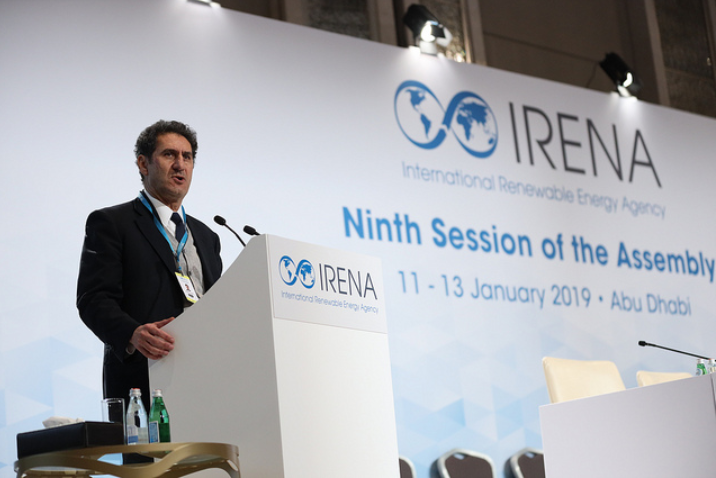
The International Renewable Energy Agency (IRENA) has elected its European candidate, Mr Francesco La Camera from Italy, as its new Director-General. Mr La Camera will succeed Mr Adnan Amin from Kenya, who has headed the organisation since it was officially inaugurated in 2011.

Read the News on the European Commission website

Photo Credits: IRENA

READ MORE
Impacts, risks, adaptations

World Economic Forum Global Risks Report 2019

The 14th edition of the Report published by the WEF provides a comprehensive view of the biggest threats we are expected to face within a 10-year future scenario: the top 5 most worrisome include extreme weather events, climate-change policy failures and natural disasters. The report presents the results of the WEF latest Global Risks Perception Survey, in which almost 1,000 decision-makers from the public sector, private sector, academia and civil society assess the main risks threatening our world. The majority of respondents expect worsening economic and political disputes between major powers this year.

Read the Full Report

READ MORE
Economy & carbon markets

European Commission Carbon Market Report

The European Commission has adopted its annual report on the functioning of the European carbon market. The report, covering the year 2017, shows that in that period the EU power sector reduced its greenhouse gas emissions for the sixth year in a row. Emissions of industrial installations, however, which receive the vast majority of their emission allowances for free, slightly increased, leading to an overall increase in ETS emissions by 0.18% in comparison to 2016. While this breaks the decreasing trend since 2013, it can be explained by the highest growth in real GDP since 2011. Verified emissions from aviation continued to grow, marking an increase of 4.5% compared to 2016.

Efforts to reduce the surplus of allowances on the carbon market are starting to be rewarded. The surplus has declined for the third year in a row, by an overall amount of almost half a billion allowances. As of next year, the Market Stability Reserve will further reduce the surplus by 24% of its overall amount each year from 2019 until 2023.

The total revenues raised from selling ETS allowances from 2012 until the end of 2017 exceeded EUR 21 billion – on average EUR 3.5 billion per year. In 2017, EU Member States spent or planned to spend 80% of auction revenues on advancing climate and energy objectives – well above the 50% rule set under the EU ETS Directive.

Source: European Commission website

Download the Report

READ MORE