Economy & carbon markets

Bridging Carbon Markets in a Fragmented Policy Landscape

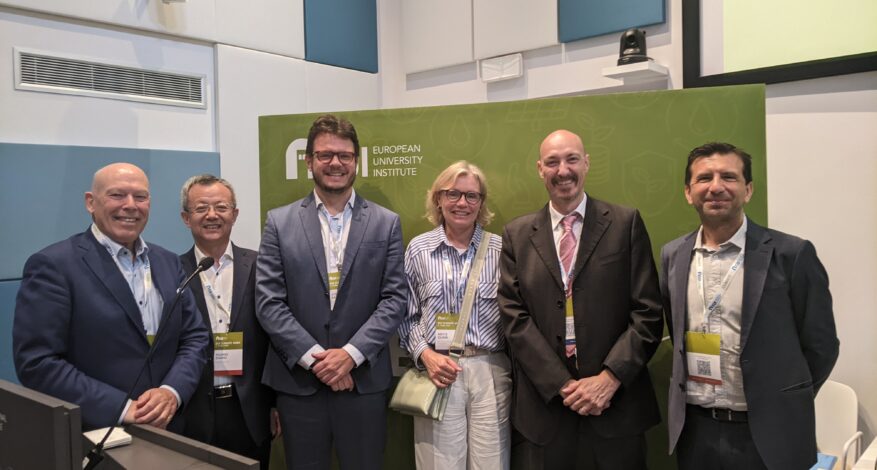
Reflections from the EAERE POC – LIFE COASE Net Zero Carbon Market Policy Dialogue on May 7

Environmental economists have long argued for integrating carbon markets to maximize environmental benefits. In practice, the number of Emissions Trading Systems (ETSs) has grown to 38 systems worldwide, but their integration has progressed slowly over the past years. At the same time, new opportunities for carbon market integration in the context of the UNFCCC and the Voluntary Carbon Market (VCM) are becoming increasingly tangible. Contributing to a better understanding of the obstacles and new prospects for carbon market integration was the aim of the EAERE POC – Life Coase Policy Dialogue on Advancing carbon market integration under Article 6, which took place on May 7, 2025 during the EUI Climate Week 2025.

The policy dialogue was moderated by the EAERE President Simone Borghesi (EUI, University of Siena), including a presentation by Baran Doda (adelphi), and a panel discussion with Nataliya Kushko (ERCST), Mette Quinn (European Commission), Xiliang Zhang (Tsinghua University) and José Pedro Bastos Neves (Ministry of Finance, Brazil). The event was concluded by the EAERE POC Chairperson Jos Delbeke (EUI).

The Current Carbon Market Landscape: Growth and Fragmentation

As of 2025, ETSs cover about 19% of global greenhouse gas (GHG) emissions. While established systems like the EU ETS, China National ETS, and UK ETS continue to evolve, new systems are also emerging. Currently, there are 20 systems under development or under consideration globally in places like Brazil, India, Türkiye, and Japan.

Despite this growth, significant fragmentation exists which limits the prospects of carbon market integration. While some linkages between compliance markets already operate smoothly, such as those in the states of the Regional Greenhouse Gas Initiative (RGGI), between Tokyo and Saitama, California and Québec, and the EU and Switzerland, broader integration faces considerable hurdles.

Key Obstacles to Linking Markets

The discussion highlighted several critical barriers to linking different ETSs. First, more and more ETSs are adopting intensity-based caps rather than absolute caps. Intensity-based caps provide compliance entities with flexibility and can support ambitious targets provided the intensity benchmarks are set sufficiently stringent, and the design of the ETS and other climate policies in the jurisdiction are well coordinated. However, they introduce greater uncertainty compared to absolute caps. Notably, the EU ETS is legally restricted to linking only with systems that have absolute emissions caps. This difference in approach makes linking more challenging.

Second, the use of offset credits varies widely across ETSs, from being completely banned to being allowed for a significant portion of compliance obligations. The variety of crediting mechanisms and the resulting differences in credit types and quality add further complexity. This fragmentation poses a significant challenge, as systems are more likely to link if they share similar designs.

Lastly, each ETS reflects its national context and interests, resulting in different policy designs. In addition, political obstacles, including climate-skeptic governments and geopolitical factors, can delay international cooperation on carbon pricing. Linking requires common rules and economic conditions, as well as trust, which are not always present.

Promising Developments under Article 6

Despite the challenges in direct linking, new opportunities for cooperation are emerging, particularly through Article 6 of the Paris Agreement. Agreements reached at COP29 in 2024 substantially advanced the market mechanisms under Article 6.2 and Article 6.4. However, critical issues remain unresolved, such as ensuring transparency and environmental integrity of the mechanisms. Capacity-building needs in developing countries are also a key issue.

The latter issue was also picked up in the discussion, which highlighted the unique challenges faced by developing countries establishing carbon markets. The right decisions on cap setting, carbon credits and linking depend on the national context. The panel speakers emphasized the need for better exchange between the Global North and Global South and more careful analysis of impacts of carbon pricing on society and economic growth in developing countries. Multilateral cooperation and clear international regulation were seen as necessary preconditions for continued carbon market development.

Looking ahead, while direct linking of ETSs is complex, particularly across systems with very different designs, the dialogue suggested that indirect linking via Article 6 mechanisms and the VCM might be a more promising avenue. A “coalition of the willing” composed of parties with common ambition and principles could also help drive progress.

Find out more in the Policy Brief State-of-play in international carbon markets 2025.

Watch the interviews with Mette Quin and Baran Doda.

READ MORE
Supported Events

1st International Alpine Workshop on Energy Economics and Policy – AWEEP 2025


The Centre for Energy Policy and Economics (CEPE), ETH Zurich, and the Institute of Economics (IdEP), USI, are pleased to announce the 1st International Alpine Workshop on Energy Economics and Policy – AWEEP 2025, to be held at the House of Sustainability in Airolo, Switzerland,  from September 20 to 22, 2025. The event is supported by EAERE.

AWEEP is designed as an intimate, high-quality forum for presenting and discussing cutting-edge energy economics and policy research with outstanding invited scholars in a new workshop format that, on top of classical sessions, introduces two distinctive features:

  1. Learning in Nature
    Sessions will include short, dynamic “hiking presentations,” during which participants share research insights during two alpine hikes (approximately three hours with an elevation gain of 400 meters). These invigorating outdoor exchanges aim to enhance creativity and deepen dialogue through physical movement and a shared appreciation of nature.
  2. Alpine Hut lifestyle Experience
    The workshop provides an authentic alpine living experience with shared accommodations and rooms, and collaborative activities such as meal preparation and setting the table at the House of Sustainability. This communal setting fosters informal discussion, personal connections, and academic camaraderie beyond the typical conference format.

Submission Guidelines

We welcome submissions from PhD students, post-docs, and junior faculty members in all energy economics and policy areas, particularly those employing applied econometric methods. Topics may include, but are not limited to:

  • Energy and environmental policy evaluation
  • Behavioral and experimental approaches to energy use

Please send your paper (PDF format) to aweep-workshop@ethz.ch with the subject line: “AWEEP 2025 Submission”.

Submission deadline: June 24, 2025
Accepted authors will be notified by July 10, 2025.

No registration fees and logistics

The workshop organization will cover the registration fee, meals, and accommodation in shared dorm-style rooms at the House of Sustainability. Upon acceptance, a detailed agenda will be shared, including the hike logistics and accommodations.

Participants

The number of participants is limited to 20 to ensure a focused and collaborative environment. We expect around 10-12 PhD students, postdocs, and junior faculty members.

Invited speakers

Organizers

AWEEP 2025 organisers are Massimo Filippini (ETH Zurich and USI) and Ken Gillingham (Yale University).

READ MORE

AERE 2025 Summer Conference


The Association of Environmental and Resource Economists – AERE, one of EAERE’s sister associations, will be holding its annual Summer Conference on May 28-30, 2025 in Santa Ana Pueblo, New Mexico (USA). The conference will feature thought-provoking presentations, interactive panels, and opportunities to collaborate with colleagues in a welcoming and collegial setting. Registration is now open. More details are available on the dedicated page.

READ MORE

PSE Summer School on Climate Change


Since 2018 Paris School of Economics – PSE has been organising a Summer School on Climate Change Economics aimed at PhD students as well as professionals working in international and national bodies. This year participants will explore topics such as the economic impacts of climate change, decarbonisation, migration, and the role of trade in mitigating climate impacts. Students will also have the opportunity to present their own research and receive feedback from faculty and peers. The School is scheduled on June 9-13, 2025 in Paris (France). Apply by May 19 here.

READ MORE

18th IAMC Annual Meeting


The 18th Integrated Assessment Modeling Consortium – IAMC Annual Meeting will take place on November 11-13, 2025 in Armação dos Búzios (Brazil). The event will take place in person, with a portfolio of online events as part of the programme. The IAMC solicits abstracts for oral and poster presentations on selected research topics, which are listed in the call for abstract. The deadline for abstract submissions is set on May 15, 2025. For more details about the Annual Meeting visit the official website.

READ MORE

19th EfD Annual Meeting


The 19th Annual Meeting of the EAERE member Environment for Development – EfD Initiative will take place on October 16-19, 2025 in Dar es Salaam (Tanzania). The Meeting is organised by EfD-Tanzania, School of Economics, University of Dar es Salaam (UDSoE), and the EfD Global Hub. More details are available at this link.

READ MORE

Dasgupta Review: Book Launch and Conference


“The Economics of Biodiversity: The Dasgupta Review” by Sir Partha Dasgupta (University of Cambridge) and co-authors, was published in early 2021. On the occasion of the publication of the official, abridged version of the 600-page scientific paper in Hungarian, Prof. Dasgupta will present his theory in a Conference to be held on May 8-9, 2025 at St. Pope John Paul II Festive Hall in Budapest (Hungary). The book launch is scheduled on May 8 at 9:00-13:00 CEST. The conference is free to attend in-person and online, upon registration.

Register here.

READ MORE

EUI-FSR online course on the Vision for Agriculture and Food


The EUI Florence School of Regulation will hold a 3-day online course on the Vision for Agriculture and Food on June 25-27, 2025. The Vision (EC, 2025) sets out an ambitious roadmap for the future of farming and food in Europe. This course will explore the key strategies behind it, including international trade partnerships, risk management, and regulatory simplification. The deadline for registration is set on May 31, 2025.

READ MORE

AARES 2026


The “Platinum Jubilee” 70th Annual Conference of the Australasian Agricultural & Resource Economics Society – AARES2026 will be held at the Adelaide Convention Centre in Adelaide (Australia) from the 11th to 13th February 2026, with the theme “Transformations in Energy, Agri-Food and Environmental Systems”.

READ MORE
Other Events

12th International Scientific Conference “Rural Development 2025: Resilience to Global Change”


The 12th International Scientific Conference “Rural Development 2025: Resilience to Global Change” will take place in Vytautas Magnus University Agriculture Academy (Lithuania) on 01-03 October 2025. In this conference, we will hear from experts across various fields – agriculture, food, forestry, IT, ecology, technology, economics, and management sciences – who will share their insights and experiences. Deadline for contributions: September 19, 2025. The event’s details and call for papers are available here.

READ MORE