JEEM / REE Workshop on Nonmarket Valuation
Check the event’s website.
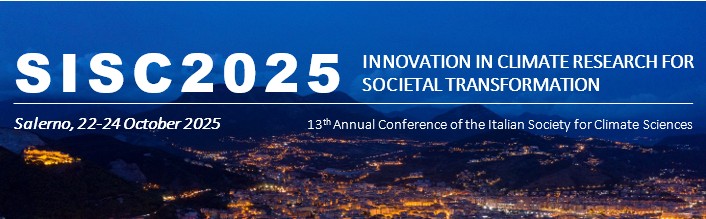
We are glad to announce the 13th Annual Conference of the Italian Society for Climate Sciences (Società Italiana per le Scienze del Clima – SISC) “SISC 2025: Innovation in climate research for societal transformation“, which will take place in Salerno (Italy) on October 22-24, 2025. SISC 2025 is supported by EAERE.
The Conference aims at connecting leading scientists, researchers, economists, practitioners, business leaders, and policy makers, whose activities are focused on different aspects of climate change, its impacts and related policies. The Conference is an important interdisciplinary platform for the presentation of new advances and research results in the fields of science and management of climate change.
Topics of interest include:
The official language of the Conference is English.
The call for abstracts and thematic sessions on the Conference’s topic are now open! You contribution must be submitted in English, no later than March 31st, 2025. Please read the full call for abstracts for the submission guidelines and the topics description.
Deadline for abstract submission: 31 Mar 2025
Notification: 9 May 2025
Deadline for registration for presenting author to be included in the programme: 6 June 2025
Preliminary programme: 30 July 2025
Conference: 22-24 October 2025
It is with great pleasure that prof. Denise Cavalcante, representing Federal University of Ceará – UFC, prof. Paulo Caliendo, representing the Latin American Institute of Environmental Taxation – ILATA, and prof. Arthur Ferreira Neto, representing Federal University of Rio Grande do Sul – UFRGS, announce that the 26th Global Conference on Environmental Taxation – GCET26 will take place in Porto Alegre (Brazil), from September 24-26, 2025, at UFRGS Law School. Denise Lucena Cavalcante and Arthur Ferreira Neto are GCET26 co-chairs. The GCET International Steering Committee members are Mikael Skou Andersen, Aarhus University, Hope Ashiabor, University of New South Wales, Janet E. Milne, Vermont Law School.
The Journal of Environmental Economics and Management – JEEM is delighted to share a last reminder for the call for papers for the 3rd biannual JEEM Conference in Environmental and Resource Economics. The conference will be held 12-13 May 2025 at Renmin University of China in Beijing (China). The call for papers is available here. The deadline for contributions is January 31, 2025.
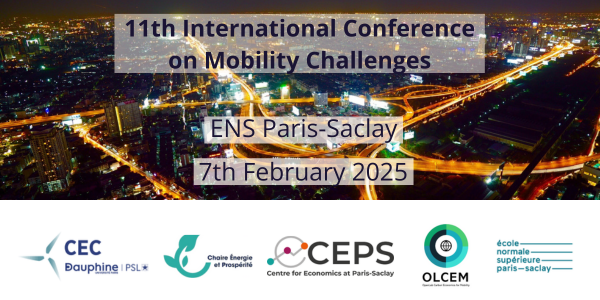
On February 7, 2025 the EAERE member Climate Economics Chair (CEC) will hold the 11th edition of the International Conference on Mobility Challenges at ENS Paris-Saclay (France) to bring together experts from academia and industry, pushing the frontier of challenges at the intersection of automotive, energy, and mobility sectors. CEC welcomes internationally renowned speakers as well as participants from the three sponsoring chairs, along with specialists from a wide range of public and private sectors (economics, technical, business, finance).
The EAAE, the European Association of Agricultural Economists organizes a Congress, which normally follows a triennial cycle. To commemorate the 50th anniversary of the Association, the next Congress will take place in Bonn (Germany) on August 26-29, 2025, just two years after the previous Congress. The event will bring together between 700 and 1000 scientists, experts, stakeholders and policy makers from all over the world to discuss the most topical and pressing issues facing the agri-food sector.
In its plenary sessions, the Bonn 2025 Congress will focus on the generally acknowledged need for food system transformation to achieve global sustainability goals. There will be an emphasis in the plenary sessions on how agricultural economics can assist the agrifood system in rising to the challenges posed by conflicting and competing interests. The contributed paper and poster sessions, as well as organized symposia, will reflect the broader activities of the community.
On occasion of the XVIII EAAE Congrees in Bonn, EAERE members are invited to submit a paper for an EAERE Organised Session. Please send your paper to fabio.santeramo@eui.eu no later than February 20, 2025.
EAERE and EAAE members can apply for a Secondary Membership with a 50% discounted fee in the other association. If you are an EAERE member in calendar year 2025 you can apply for an EAAE Secondary Membership with a 50% discounted fee.
Deadline for contributions: FEB 15, 2025
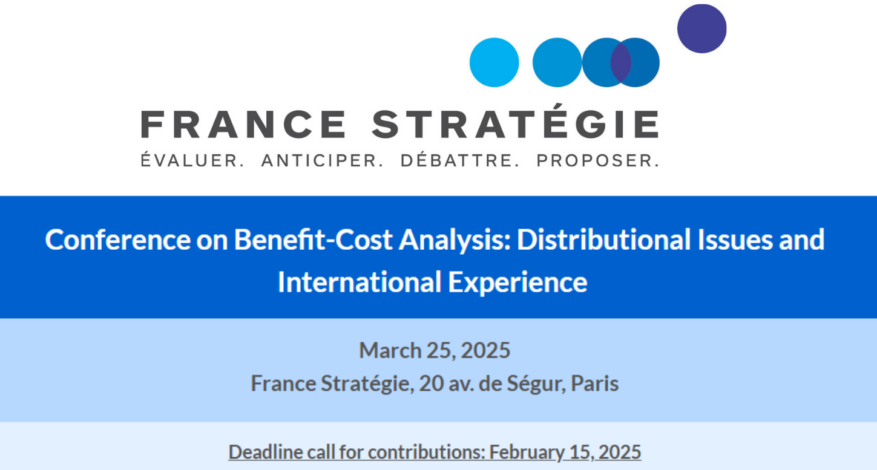
The Scientific Council for Cost-Benefit Analysis at France Stratégie is glad to announce the Conference on the topic “Benefit-Cost Analysis: Distributional Issues and International Experience” to be held in Paris (France) on March 25, 2025.
Distributional issues are important in the pursuit of a just transition, as highlighted by the IPCC, as well as the Haut Conseil pour le Climat (High Council for Climate) in France. As a matter of fact, many public projects, including public investments, are motivated by a concern for disadvantaged areas or segments of the population. Inequalities in infrastructures between districts and between cities, in connectivity to relevant economic and cultural hubs, in access to public goods and facilities, in vulnerabilities to externalities, and in environmental quality very often undergird public programs related to education, health, security or environmental preservation. Imperatives of social acceptability further justify paying attention to these aspects, and repeated protests in France about environmental regulation (“bonnets rouges”, “gilets jaunes”, farmers) have made it plain to policy-makers.
Nevertheless, in France, benefit-cost analysis, while systematically applied to public investments, usually leaves distributive impacts of the projects out of the quantitative assessment. In many other countries, in contrast, guidelines for the incorporation of distributive impacts into the computation of the net value have existed for some time. In the UK, for instance, the Green Book recommends the transparent use of weights in the aggregation of monetized impacts where distributional effects are significant and well understood. In the European Union, non-binding guidelines propose to use weights that are inversely proportional to a power function of the living standards of the relevant social groups. A particularly important 2023 revision to the guidelines published by the White House in the USA (Circular A4) has introduced the possibility for agencies to also rely on weights, and there is even a specific recommendation for the value of the coefficient that should be used in such weights, based on estimates of diminishing marginal utility.
This conference initiates an effort to improve the integration of distributive effects into benefit-cost analysis in French agencies. This conference will be followed by a revision of the guidelines based on the best practices and sound theoretical and methodological bases. Its conclusions will be a key input in the process leading to the new guidelines.
The incorporation of distributive issues is generally considered difficult not only because of the need to justify the value judgments underlying weights, and the complication implied by weighting not only the benefits but also the costs of the projects, but also because the estimation of impacts for different social groups (by area, age, socio-economic status, income) may be difficult and involve assumptions about behaviors, about adjustments of taxes and transfers to the impacts on households, and about general equilibrium effects through variations in prices and wages at the local level. The conference will cover both aspects of this topic.
The Scientific Council for Cost-Benefit Analysis at France Stratégie invites proposals for contributions to its international Conference on distributional impacts and cost-benefit analysis. Submissions in the form of an extended abstract of about 400 words should be sent to jincheng.ni@strategie.gouv.fr before February 15, 2025. Notification of decision will be received by February 22, 2025.
Participants will be requested to cover their transportation and lodging costs but there is no registration fee. Participants to the seminar, which takes place in the afternoon, are also invited to attend the morning conference.
09:00 Welcome and introductions
09:15 Keynote : Equity in benefit-cost analysis, from principles to practice
Luc Baumstark (University of Lyon) and Marc Fleurbaey (Paris School of Economics)
10:00 Break
10:15 Round table 1: Distributive impacts in the computation of a net present value: international experience
Ben Groom (Exeter), Massimo Florio (Università degli Studi di Milano), Danaé Arroyos-Calvera (Birmingham), Doramas Jorge Calderon (European Investment Bank)(TBC)
11:30 Round table 2: Identifying relevant social groups and estimating distributive impacts
Antoine Bozio (Paris School of Economics), Maria Börjesson (Linköping University), Susana Mourato (LSE)(TBC)
12:45 Closing words
13:00 Lunch for invited participants
14:00 Seminar on the equitable future of cost-benefit analysis
17:30 End of seminar
The Organising Committe members are Luc Baumstark, Frédéric Cherbonnier, Marc Fleurbaey, Pascal Gautier, Jean-Michel Josselin, Yann Kervinio, Jincheng Ni, Jean-Paul Ourliac, Aude Pommeret, Emile Quinet, Nicolas Riedinger, Katheline Schubert.
The EAERE Supported Deloitte Climate & Sustainability Competency Lab 2025, a free online academy that aims to bridge the gap between science and the business community realised with EAERE’s scientic support, was launched in January 2025. The second lecture will be held on February 20 at 10:30 CET by Ben Groom, Dragon Capital Chair in Biodiversity Economics at the University of Exeter and EAERE Policy Outreach Committee member. He will deliver a lecture titled “Nature positive impacts in business organisations: measuring and valuing biodiversity”. Drawing from numerous studies, including the Dasgupta Review, he will analyse the multiple ways of measuring biodiversity and its multiple economic values.
Click here to register to the webinar.
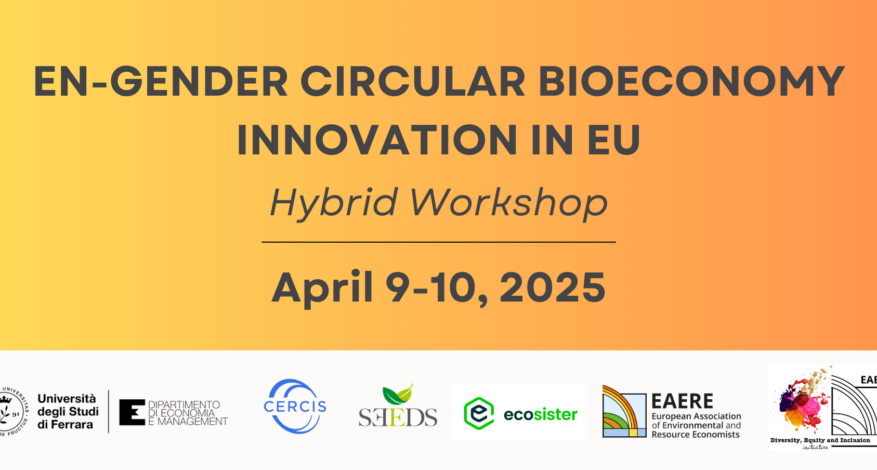
The Executive Committee of the EAERE Diversity, Equity and Inclusion Initiative (DEI) is glad to announce an hybrid workshop on the topic of “En-Gender Circular Bioeconomy Innovation in the EU” to be held at University of Ferrara (Santa Lucia Auditorium, via L. Ariosto 35, Ferrara, Italy) on April 9-10, 2025.
The event is part of a series of workshops organised by the EAERE DEI Executive Committee in collaboration with the University of Ferrara in 2025 and 2026.
This workshop invites scholars, researchers and young researchers to explore the crucial interconnections between bioenergy, eco-innovation, and gender dimensions within the framework of
the European Green Deal and the green transition. As Europe intensifies its efforts to achieve climate neutrality, bioenergy emerges as a key component in decarbonising energy systems, promoting rural development, and supporting a circular economy. This workshop aims to examine how eco-innovations in bioenergy—ranging from advanced biofuels to sustainable biomass production—can advance these objectives while addressing socio-economic, environmental, and gender equity challenges.
Through interdisciplinary discussions, the workshop seeks to identify policy recommendations and strategies to enhance the integration of bioenergy into Europe’s green economy, ensuring that the energy transition benefits all.
The Keynote lectures will be given by Professor Sevilla Almudena, LSE Department of Social Policy, and Professor Pelin Demirel, Imperial College London.
In order to join the workshop in-person or online, please fill out the registration form.
Connect to this Google Meet link to follow the workshop online: https://meet.google.com/xsd-fwkc-daw.
9:00 – 9:30 Registration
9:30 – 10:30 Institutional Greetings
Moderated by Riccardo Colantuono | University of Siena
Prof. Tamara Zappaterra, Vice-Rector for Diversity, Equity and Inclusion in UNIFE
Prof. Simone Borghesi, President EAERE
Prof. Massimiliano Mazzanti, Department of Economics and Management Director in UNIFE
10:30 – 11:00 Coffee Break
11:00-12:00 Keynote: Prof. Almudena Sevilla
12:00-13:00 First paper session | Chair: Giulio Corbelli
13:00-14:00 Lunch break
14:00-15:00 Second paper session | Chair: Alessandro Muscio
15:00-15:30 Coffee break
15:30-16:30 Third paper session | Chair: Ilaria Dibattista
16:30 – 17:00 Networking Ice Breaking
19:30 Social Dinner (self-paid)
Cusina e Butega Corso Porta Reno, 28, 44121, Ferrara Italy 7:30 p.m. . Google Maps link
9:00-9:30 Registration
9:30-10:30 Keynote: Prof. Demirel Pelin
10:30-11:00 Coffee break
11:00-12:45 Fourth paper session | Chair: Ana Gabriela Encino-Munoz
12:45 – 13:00 Closing words by EAERE President Prof. Simone Borghesi
Ferrara can be reached via the airport of BOLOGNA or VENICE and then via train to Ferrara. From the airport of BOLOGNA, there is a shuttle to the BOLOGNA STAZIONE CENTRALE (train station) and then switch trains to Ferrara (30 min or maximum 50 min) OR a direct bus shuttle Bus&Fly.
The workshop will be held in Via Ludovico Ariosto, 35 in the S. Lucia Auditorium. You can find here the Google Maps link to use.
Abstract Submission Extended Deadline: February 19, 2025
Notification of Acceptance: March 10, 2025
Full Paper Submission Deadline: March 30, 2025
For further information please contact: nfrfbl@unife.it
Denitsa Angelova
Lory Barile
Ilaria Dibattista
Asia Guerreschi
Phoebe Koundouri
Massimiliano Mazzanti
Fabiola Onofrio
The EAERE Supported Event PhD Summer School on the Economics of Climate Change and Energy Transition will be held at Lancaster University Management School, in Bailrigg, Lancaster (UK), on June 4-6, 2025.
About the Summer School
The aim of the Summer School is to provide an overview of cutting-edge economics research on climate change and energy transition issues, and to offer opportunities to PhD students for interactions and discussions with experts in the field.
Keynote Lectures
The Keynote Lectures will be given by Professor Valeria Costantini (University of Roma Tre) and Professor Stefan Ambec (Toulouse School of Economics, INRAE, University of Toulouse Capitole).
Prof. Valeria Costantini will explore the challenges of transitioning to sustainable development, examining climate change’s intersection with socioeconomic factors, migration, and inequality, and evaluate policy responses ranging from international agreements to the EU’s green energy initiatives and carbon adjustment mechanisms. Prof. Stefan Ambec will introduce students to the research frontier on the design of public policies and electricity markets for the transition to a low carbon economy.
Applications
Students interested in participating in the Summer School should fill in the application form by April 1, 2025. Decisions will be announced soon after the deadline.
Further Information
For any questions or further information please email the event organizers: Aurelie Slechten or David Rietzke.