CERCIS Annual Workshop
Call for paper details can be found here
The transition to net zero emissions by 2050 could hinder environmental and biodiversity conservation. EAERE promotes the research-policy interface by examining this issue from an energy, marine and land-use standpoint. This provides the science-based framework to analyse the key role that renewable assets, reporting standards and sustainable finance can play to drive a sustainable transition.
PROGRAMME:
Climate neutrality, energy transition and biodiversity : synergies, trade offs and policy instruments
Simone Borghesi – Director Florence School of Regulation Climate, European University Institute and University of Siena, Italy
Bringing climate, biodiversity and other ecosystem services into policy and economic decision making
Ian Bateman – OBE, US-NAS, FBA, FRSA, FRSB, Director: Land, Environment, Economics & Policy Institute (LEEP), University of Exeter Business School, UK
Sustainable Blue Growth: Science Driven Marine Spatial and Dynamic Planning
Phoebe Koundouri – President-Elect, European Association of Environmental and Resource Economists
Fellow, World Academy of Art and Science, Director ReSEES Research Laboratory, Athens University of Economics and Business
GRI Standard for biodiversity
Peter Paul van de Wijs – Chief External Affairs Officer, Global Reporting Initiative (GRI)
Harold Pauwels – Director Standards, Global Reporting Initiative (GRI)
The importance of biodiversity for investors
Shane Swords – Managing Director, Head of Investor Relations, NextEnergyCapital
NextEnergyCapital and solar’s role in achieving climate neutrality and improved biodiversity
Michael Bonte-Friedheim – Founding Partner & Group Chief Executive Officer, NextEnergyCapital
Protecting life diversification through standards and nature-based solutions
Markus H.-P. Müller, Managing Director, Global Head of Chief Investment Office Private Bank, Deutsche Bank
The EU Hybrid Side Event at COP26 – Climate Neutrality and Biodiversity: renewables assets, reporting standards and sustainable finance will take place on November 3, 2021 5:00 PM to 6:00 PM CET time.
In order to participate, register here
The event in presence will take place in Room 3.G.5 of the EU Pavilion in Glasgow Scottish Event Campus – Exhibition Way – Glasgow G3 8YW.
Video recording available here
The conference will cover the main climate-related existing policies at EU, national, international and sub-national levels. It will include three sessions on Energy Efficiency and Renewables, Environmental taxation, and Emissions trading. In addition, the conference will comprise a keynote speech from Estelle Cantillon, and a policy session focused on carbon market integration.
Due to the travel and public gathering restrictions taken to limit the spread of COVID-19, the FSR Climate Annual Conference will be held online through Zoom Webinar. Register here
Chair: Simone BORGHESI, FSR Climate – European University Institute
10:00-12:00 – Session on Emissions trading
14:00-16:00 – Session on Environmental taxation
10:00-11:00 – Keynote Speech
11:10-12:40 – Policy Session “Deepening international cooperation on emissions trading: possible reforms for integration”
14:00-16:00 – Session on Energy Efficiency and Renewables
The number of countries announcing pledges to achieve net-zero emissions over the coming decades continues to grow. But the pledges by governments to date – even if fully achieved – fall well short of what is required to bring global energy-related carbon dioxide emissions to net zero by 2050 and give the world an even chance of limiting the global temperature rise to 1.5 °C. The International Energy Agency recently published a comprehensive study of how to transition to a net zero energy system by 2050 while ensuring stable and affordable energy supplies, providing universal energy access, and enabling robust economic growth. The study sets out a cost-effective and economically productive pathway, resulting in a clean, dynamic and resilient energy economy dominated by renewables like solar and wind instead of fossil fuels. It also examines key uncertainties, such as the roles of bioenergy, carbon capture and behavioural changes in reaching net zero. The webinar will be the occasion to discuss the content of IEA Report on NetZeroby2050 with Laura Cozzi, IEA Chief Energy Modeller, who led the writing team.
Join us on Thursday October 28, 2021 from 5:00 to 6:30pm CET to hear from Laura Cozzi (International Energy Agency). Her presentation will be followed by a discussion by Carlo Carraro (Ca’ Foscari University of Venice, CMCC and CEPR) and a Q&A session with the audience.
Register here!
Detailed programme is available here
For reference: UK Government’s response to the Dasgupta Review
The first response stems from a meeting with the UK Treasury on the issue of environmental discounting, chaired by Ben Groom. The workshop included presentations by EAERE President Christian Gollier, Moritz Drupp and Anthony Millner. After hearing arguments on both sides, Treasury opted to recommend a review of environmental pricing rather than having an environmental discount rate across the board. New guidance on this will be written in this regard in the coming months for the Green Book refresh in Spring 2022. This conclusion responds to this comment in the UK Government response to the Dasgupta review on page 22: “The Green Book continues to be updated in line with emerging evidence and best practice. For example, HM Treasury is conducting an expert review into the application of the discount rate for environmental impacts, on which Professor Dasgupta will be consulted, and which will be concluded this year”.
The conclusion can be found here
Second response: biodiversity net gain guidance.
The UK Government response to the Dasgupta Review states on page 22:
“To this end, HM Treasury has convened a group of experts, including academic economists and scientists as well as practitioners, to produce supplementary guidance on Biodiversity Valuation for the Green Book, in addition to the guidance on natural capital. This world-leading guidance is expected to be published later this year and will complement the Environment Bill’s biodiversity net gain provisions in supporting better consideration of biodiversity in decision-making.”
Ian Bateman, Ben Groom, EJ Millner Gulland and Rosie Hails are all part of this group, together with economists from Treasury, Defra Forestry Department team. The team is hoping to provide guidance on biodiversity for the Treasury Green Book on CBA.
In September 2021 the Israeli parliament – the Knesset – gave its approval to the 2021-2022 state budget in its first reading. For the first time in the history of Israel, the budget introduces a carbon tax. The carbon tax is far from reflecting efficient emissions pricing: excise duty will gradually increase until 2028, reflecting the full price of carbon (which is also updated annually), but the tax on gasoline and diesel will reflect only 30% of the carbon price. In contrast, the excise tax on fuel oil will reflect not only the price of carbon but also the price of SOX depending on the Sulfur content.
There is a lot to criticize in the tax outline. But, in my humble opinion, this is a real revolution in Israeli policy. I have been studying energy & climate change economics for almost two decades and can testify that until recently, policymakers in Israel have refrained from dealing with environmental issues, arguing that in our small economy the priority should be given to other urgent issues such as unemployment, inflation, or geopolitical tension. Until a year ago, a carbon tax was absent from the agenda of the Israeli academy as well as the Ministry of Finance. The Ministry of Energy vehemently opposed it.
A combination of recent processes contributed to the dramatic change:
First, the COVID-19 pandemic has increased the government debt. The Ministry of Finance understood that raising VAT or income tax during the ongoing crisis means political suicide. Accordingly, the carbon tax backed by social-environmental rational suddenly became a feasible option for raising government income.
Second, for the first time in Israeli politics, the climate crisis has come out of the esoteric corner: the topic was included in the government’s guidelines thanks to the left-wing Meretz party that pushed to raise the issue upon joining the fragile coalition; carbon tax hit the Central Bank’s agenda thanks to the Governor Prof. Amir Yaron. Furthermore, the State Comptroller opened an investigation on how Israel copes with risks imposed by climate change. In parallel, the professional staff of the Ministry of Environmental Protection managed to collaborate with the other relevant Government Ministries, academics, and stakeholders in the process of formulating recommendations for carbon tax policy. The policy recommendations were based on research findings mediated to the various levels.
The outline of the carbon tax, planned for a long-term increase, has also an important role in providing certainty about Israel’s long-term policy as it sends an incentive for markets, entrepreneurs, and firms to effectively use various means to reduce emissions and invest in new technologies, processes and ideas to further reduce emissions.
The critics of the proposed tax are right – it is not optimal. I hope that decision-makers will be able to continue to update it, as well as to accompany it with supportive policies so that the State of Israel joins the global effort of reaching Net Zero at minimal cost for the economy and the society.
Ruslana Rachel Palatnik,
Senior Lecturer, Department of Economics and Management, The Max Stern Yezreel Valley College, Israel
Senior Researcher, NRERC- Natural Resource and Environmental Research Center, University of Haifa, Israel
Senior Guest Research Scholar at the Energy, Climate, and Environment (ECE) Program at IIASA- International Institute for Applied Systems Analysis, Austria
Two members of the Policy Outreach Committee, Xavier Labandeira and Aldo Ravazzi, participated as EAERE observers in the approval process of the Summary for Policy Makers (SPM) of the IPCC’s Working Group on the physical science basis of climate Change (WG1) that took place between 28 July and 8 August 2021. This SPM is a non-technical synopsis that condenses into about 40 pages the contribution of WG1 to the Sixth Assessment Report of the IPCC, a document of about 3000 pages in which some 200 authors from all over the world have participated during the last three years. The approval of SPMs is carried out line by line by delegates from the approximately 200 governments that are part of the IPCC, with the presence of the report’s co-chairs of the working group and author representatives from all its chapters.
The WG1 SPM, presented in public on 11 August, points out that human influence has warmed the atmosphere, the ocean and the land, causing changes in the climate system that are unprecedented in many centuries. The document indicates that global surface temperature will continue to rise until at least mid-century under all the considered emission scenarios, such that during the 21st century global warming of 1.5-2ºC will be exceeded unless there are deep reductions in GHG emissions in the coming decades.
The gloomy conclusions of the WG1 SPM were widely echoed by the media, which highlighted the inevitability of the devastating impacts of global warming, although noting that there is still a small window to prevent the worse outcomes. Environmental organizations, also present as observers in the SPM approval process, claimed that while this is not the first generation of world leaders to be warned by scientists of the severity of the climate crisis, they are the last who can afford to ignore it.
Antonio Guterres, Secretary General of the UN, indicated that the report is a red code for humanity and assured that the viability of our societies depends on the actions of governments, companies and citizens to limit the increase in temperature to 1.5ºC. Alok Sharma, president of COP 26, underlined that the impacts of the climate crisis can be seen throughout the world and that, unless immediate action is taken, we will see how the worst effects impact lives, livelihoods and natural habitats.
WG2 (Impacts, adaptation and vulnerability to climate change) and WG3 (Mitigation of climate change) of the IPCC are in the process of completing their reports and will present their SPMs within the next few months.
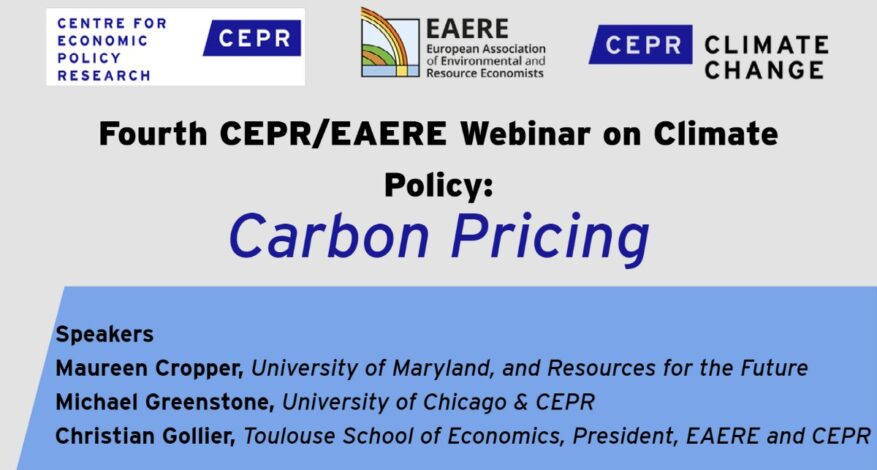
Carbon pricing is useful to induce all GHG emitters to internalize the climate damages associated to their emissions. But even in countries without a market pricing mechanism, it is important to value carbon in order to perform the socio-economic evaluation of the myriad of climate policies that will have to be implemented to attain their emission target. During this webinar, three panelists will summarize their findings about what carbon price/value should be recommended, or about the rate at which this carbon value should grow over time. The panelists will also identify the sources of uncertainty and of scientific disagreement surrounding this economic approach to fighting climate change.
Join us on Thursday September 30, 2021 from 5:00 to 6:30pm CEST to hear presentations from:
– Christian Gollier, President, EAERE, Executive Director, Toulouse School of Economics, and Research Fellow, CEPR
– Maureen Cropper, Professor of economics, University of Maryland, and Senior fellow, Resources for the Future
– Michael Greenstone, Milton Friedman Distinguished Service Professor in Economics, University of Chicago and Research Fellow, CEPR
Their 20-minute presentations will be followed by a 25-minute open discussion & Q&A session.
Register here
Video recording here