Supported Events

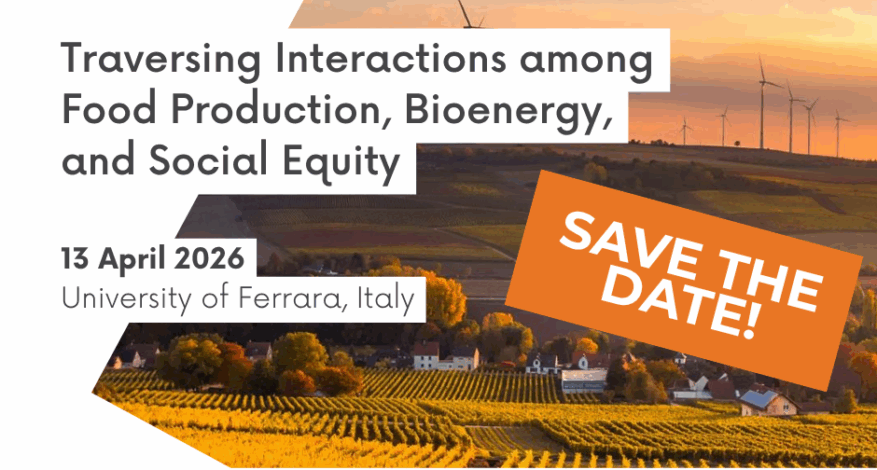
Traversing Interactions among Food Production, Bioenergy, and Social Equity – DEI Workshop 2026

The Executive Committee of the EAERE Diversity, Equity and Inclusion Initiative (DEI) is glad to announce a workshop on the topic of “Traversing Interactions among Food Production, Bioenergy, and Social Equity” to be held at University of Ferrara (Italy) on April 13, 2026.

Workshop overview

In response to the urgent need for sustainable development practices that address the dual challenges of climate change and resource depletion, this workshop invites academics, researchers, and early-career scholars to explore the intersections of food production, bioenergy, water, environmental accounting, and issues of social equity and inclusion of social groups marginalized on account of gender, ethnicity, religion, etc. As the global community intensifies efforts to mitigate climate impacts, the integration of food systems and bioenergy represents both a critical opportunity and a significant challenge.

We seek contributions that examine how environmental accounting frameworks can be utilised to assess the environmental impacts and resource efficiencies of interconnected food and bioenergy systems while addressing social dimensions such as equity and inclusion. Through an interdisciplinary lens, we aim to foster discussions on the complexities of navigating these sectors toward sustainable and equitable futures.

Keynote speaker

The keynote lecture will be delivered by Sandra Aguilar-Gomez (Tecnológico de Monterrey).

Call for papers

We invite papers that address, but are not limited to, the following topics:

  • Bioenergy and Food Systems: The role of circularity in reducing the carbon and water footprint of food and energy production systems, particularly concerning the arising income opportunities for marginalised and vulnerable communities.
  • Land Use and Equity: The challenges and opportunities of land use competition between food, feed and bioenergy crops, focusing on access, equity, and the potential impacts on local and global food security.
  • Water Consumption and Equity: Water use competition between food and bioenergy crops, industry, and municipal uses with a focus on access to clean water and sustainable management of freshwater resources and practices that safeguard the rights of marginalized communities and balance ecological health with human needs.
  • Environmental Accounting for Equity: The application of environmental accounting tools (Life Cycle Assessment (LCA), carbon and water footprinting, and ecosystem service valuation, etc.) to measure the environmental impacts and mitigate risks, while ensuring social justice and fairness are accounted for. The role of consumer responsibility and product labeling for sustainable and equitable development.
  • Social and Environmental Trade-offs: Innovative approaches to accounting for the trade-offs between food security, bioenergy production, and ecosystem health, focusing on inclusive practices that support equitable development.
  • Gender and Equity in Food Systems and Bioenergy: Exploring the role of gender (or another marginalizing characteristic) and equity in shaping food production, water, and bioenergy strategies, and how inclusive practices can enhance sustainability across all sectors.

Submission Guidelines

We invite both theoretical and applied research that advances our understanding of the complex relationships between food production, water, bioenergy, and social equity. Submissions should highlight innovative ideas, research findings, or case studies that contribute to this important dialogue. Authors should aim to address both environmental and socio-economic factors, integrating diverse perspectives and methodologies.

Please submit your abstract (maximum 300 words) to nfrfbl@unife.it by 15 February 2026. Abstracts should include a brief description of the research focus, methods, and expected outcomes. Authors of selected abstracts will be invited to submit full papers for presentation at the workshop.

We look forward to engaging with a diverse group of scholars committed to advancing sustainability through inclusive and interdisciplinary research. Join us in this important conversation to explore pathways toward more equitable and sustainable food and bioenergy systems.

If you do require a VISA, please let us know when applying for the workshop or as soon as the registrations open. For any queries on the issue, please contact Fabiola Onofrio at nfrfbl@unife.it

Important Dates

  • Abstract Submission Deadline: 14 November 2025 – DEADLINE POSTPONED to February 15, 2026
  • Notification of acceptance: 5 December 2025
  • Full Paper Submission Deadline – Optional: 20 December 2025
  • Opening of registration: 20 December 2025
  • Closing of registrations: 10 February 2026
  • Workshop: 13 April 2026

Full Programme

You can see the full programme here.

Scientific Committee

Denitsa Angelova, WU Vienna and Ca’ Foscari University of Venice
Dafna DiSegni, University of Rhode Island
Asia Guerreschi, University of Ferrara
Pamela Giselle Katic, University of Greenwich
Massimiliano Mazzanti, University of Ferrara
Fabiola Onofrio, University of Ferrara

Organisers

The event is part of a series of workshops organised by the EAERE Diversity, Equity and Inclusion Initiative – DEI Executive Committee in collaboration with the University of Ferrara in 2025 and 2026.

More information

For inquiries, please contact Fabiola Onofrio (University of Ferrara, EAERE DEI Executive Committee) at nfrfbl@unife.it

READ MORE

DTU’s Summer School on Energy Economics


The Technical University of Denmark – DTU is glad to announce the PhD Summer School on Energy Economics “Energy transition and society” to be held on June 1-5, 2026. Anne Neumann (Norwegian University of Science and Technology) and Sonia Yeh (Chalmers University of Technology) will hold the keynotes lectures. Applications are welcome by May 1, 2026. Read more about the School and apply at this link.

READ MORE

Unife-SEEDS workshop: Integrating Environmental / Economic Accounts: National and Regional Dimensions


The University of Ferrara and SEEDS are pleased to announce the workshop “Integrating Environmental / Economic Accounts: National and Regional Dimensions” to be held on September 10, 2025 at the University of Ferrara (Italy).

Speakers

  • Giovanni Marin, Università degli Studi di Urbino Carlo Bo

Submissions

In a context of increasing pressure to align economic development with environmental sustainability, the need for robust and coherent accounting systems is more urgent than ever. Contributions are sought that address the challenges and opportunities of implementing integrated accounts, with particular attention to their policy relevance, comparability, and effectiveness in informing decision-making.

Topics of Interest Include (but are not limited to): Methodological advances in the System of Environmental-Economic Accounting, Regional disparities and data disaggregation in environmental-
economic accounts, Applications of integrated accounts in sustainability policy and planning, Ecosystem services valuation and accounting, Case studies of national and regional implementation, Institutional and
governance challenges in data integration, and Links between environmental accounting, green growth, and the circular economy.

Submissions of long abstract are expected by July 15, 2025 via this form.

Location

Aula Magna | Università di Ferrara | Via Voltapaletto, 11

READ MORE

Unife-SEEDS Workshop: A Survey-Based Analysis of Firms’ Strategies and Socio-Economic Impact


The University of Ferrara and SEEDS are pleased to announce the workshop “A Survey-Based Analysis of Firms’ Strategies and Socio-Economic Impact” to be held on September 8, 2025 at the University of Ferrara (Italy).

Speakers

  • Francesco Quatraro, University of Turin
  • Claudia Ghisetti, Bicocca University

Submissions

This workshop aims to explore the potential of innovation survey data to unveil the intricate relationships between innovation, firm behaviour, and broader socio-economic outcomes. We welcome contributions that investigate techno-organisational change, eco-innovation, digital transformation, labour market implications, and regional innovation systems, among other themes.

Topics of Interest Include (but are not limited to): The role of innovation in shaping firms’ socio-economic performance, Organisational change and strategic behaviour in response to innovation pressures, The impact of digital and green transitions on business models, Firm heterogeneity in innovation capabilities and strategies, Policy evaluation through innovation survey data, Comparative analyses using CIS and other national/regional surveys, Methodological advances in the analysis of innovation surveys, Sectoral and regional dynamics in innovation-driven change.

Submissions of long abstract are expected by July 15, 2025 via this form.

Location

Aula Magna | Università di Ferrara | Via Voltapaletto, 11

READ MORE

Manchester Workshop on the Economics of Energy Transition – MWEET


The University of Manchester is pleased to announce the inaugural Manchester Workshop on the Economics of Energy Transition – MWEET. This in-person event, sponsored by the Hallsworth Conference Fund at Manchester, will take place on December 11-12, 2025 at the University of Manchester (UK).

Keynote speakers

  • Shanjun Li (Cornell University)
  • Michael Pollitt (University of Cambridge).

Submissions

The workshop will feature two parallel sessions, covering a range of topics central to the economics of energy transition, including:

  • Energy Transition and Labour Markets
  • Energy Prices, Competitiveness, and Equity
  • Decarbonizing the Electricity Sector
  • Challenges in Decarbonizing Energy Demand
  • Energy Security, Industrial Policy, and Resilience

Submissions are invited from researchers in the field, especially PhD students and early career researchers. Please submit a two-page abstract or a full draft using  this form and email your abstract/paper to mweet@manchester.ac.uk.

Deadline for submissions: August 1, 2025.

Participation

There is no registration fee for presenters.  Limited funds are available to cover accommodation expenses of PhD students and early career researchers.

READ MORE
Annual Conferences

31st EAERE Annual Conference


The 31st EAERE Annual Conference – EAERE 2027 will take place from June 28th to July 1st, 2027 in Madrid (Spain). The Conference is co-organised and hosted by the Universidad Autónoma de Madrid – UAM, and the Local Organising Committee Chair is Carmen Arguedas (UAM, EAERE Council member). Do not miss the EAERE 2027 video presentation and subscribe to EAERE’s YouTube channel.

READ MORE
Supported Events

WCEREA webinar: The political economy of carbon pricing


The World Council of Environmental and Resource Economists Associations – WCEREA is pleased to announce the webinar on “The political economy of carbon pricing” to be held on September 9, 2025 at 9:00 – 10:30 am Pacific Time (see time converter here).

The Webinar

There is a considerable number of carbon pricing initiatives around the world. Nevertheless, in general, the level of these prices is lower than needed to mitigate emissions sufficiently to hit the Paris Agreement targets on time. A major reason behind low carbon taxes and high carbon caps seems to be political. Authorities are not willing to pay the political cost of higher carbon prices. A possible increase in the energy costs and how this increase is distributed among different income groups is not the only driver of the political cost. Part of the policy cost arises because carbon prices address a global problem, not a national one. Therefore, international cooperation plays a significant role in the domestic political economy of carbon prices.

To induce the level and speed of mitigation that carbon prices alone at politically viable levels are unlikely to achieve, several colleagues have suggested that climate policy should adopt a more “holistic” approach. According to this approach, carbon taxes should complement other instruments, such as subsidies to R&D, more “prescriptive” instruments, and a carbon border adjustment mechanism. In this scenario, important questions remain to be answered: Are high carbon prices doomed as climate policy instruments? How does international cooperation affect the chances of observing effective carbon prices in the future? What is the role that a carbon border adjustment mechanism should have? In this webinar, we gathered three distinguished scholars to present their views on these pressing questions.

Moderator

Marcelo Caffera, University of Montevideo

Panelists

Registration

The event will take place online on Zoom platform.

Register at https://cmcc-it.zoom.us/webinar/register/WN_4zbd5MRERGiHB2m94xTsVw#/registration

Organisers

The webinar is organised by the WCEREA Board.

WCEREA Member Associations

AAERE, Asian Association of Environmental and Resource Economics

AERE, Association of Environmental and Resource Economists

AFAERE, African Association of Environmental and Resource Economists

EAERE, European Association of Environmental and Resource Economists

WCEREA Partner Association

LAERE, Latin American Association of Environmental and Resource Economists

READ MORE

EAAE-EAERE Workshop: Valuation Methods in Agro-food and Environmental Economics. What’s next?

The European Association of Agricultural Economists – EAAE and the European Association of Environmental and Resource Economists – EAERE are pleased to announce the workshop on “Valuation Methods in Agro-food and Environmental Economics. What’s next?“, to be held at the Polytechnic University of Catalonia in Castelldefels (Spain), on December 3-4, 2025. This workshop is the first EAAE-EAERE jointly organised event.

The deadline for paper submission has been postponed to September 30, 2025.

The workshop

The workshop constitutes an opportunity to bring agro-food and environmental economists together to review the state-of-the-art on valuation methods as well as future challenges. This workshop has the objective of becoming a forum in which scientists dealing with valuation methods periodically meet to discuss both empirical and methodological questions of different methodologies. Moreover, it aims at opening the door for new editions in the collaborating framework between EAAE and EAERE.

The workshop aims at covering the following topics:

  • Development, application and theoretical basis for valuation methods in general;
  • Incorporating risk and uncertainty in valuation methods;
  • Incentive compatible alternatives and experimental economics;
  • Methodological issues raised in applications;
  • Advantages and disadvantages facing alternative valuation methods;
  • Data input, econometric analysis and interpretation stages.

Keynote speakers

  • Salvatore di Falco, University of Genève
  • Stephane Hess, University of Leeds and Delft University of Technology

Expected participants

The EAAE-EAERE Workshop on Valuation Methods in Agro-food and Environmental Economics is aimed at scientific audience from different disciplines interested in Valuation Methods both from a methodological and/or empirical point of view, who are member of the EAAE or EAERE at the time of registration for the seminar. To become a member, please visit the EAAE or EAERE websites.

Submissions

To participate in the workshop, interested people must submit a contributed paper proposal (around two pages, single space and standard Arial 11 point type) which should include at least the motivation and the methodological framework plus an outline of main results. The file must be named with the last name of the first author. All documents should be submitted electronically in PDF format (name-abstract.pdf) to the following electronic address: eaaeworkshop@creda.es. Please note that if the same authors send more than one manuscript, the index number must be used as follows: name1.pdf, name2.pdf. Be sure to review the PDF file you have created before sending it to check that text and formulas (if any) have transferred correctly.

The Steering Committee invites submissions on the following topics:

  • Applications in Food Economics and consumer behaviour;
  • Applications in Environmental Natural Resource Economics;
  • Applications in Agricultural, Food and Environmental Policies;
  • Comparisons of reliability of alternative valuation methods;
  • Methodological issues (e.g. respondents’ prior knowledge and involvement, heterogeneity, risk and uncertainty);
  • Modelling tools for generated data.

The deadline for paper proposal submissions has been postponed to September 30, 2025.

Evaluation

Proposals will be evaluated by two referees following a standard double-blind process. Referees will be suggested by the Steering Committee. Authors from accepted proposals will be notified by October 20, 2025. A maximum number between 30 and 40 proposals will be accepted. Authors from accepted proposals will be requested to send the full paper by November 10, 2025. In the notification letter, the Organizing Committee will provide guidelines for paper submission.

Programme

The workshop’s programme will be available in due time.

Registration fees

Fees paid prior November 10, 2025: € 275.

Fees paid after November 10, 2025: € 325.

The fee covers documentation, lunches, workshop dinner and coffee breaks.

Venue and logistics

The Workshop will be held in the Escola d’Enginyeria Agroalimentària i de Biosistemes de Barcelona (EEABB), at the Polytechnic University of Catalonia, in Castelldefels (Spain), 30 minutes far by train from Barcelona city centre. For more information on how to reach the venue and accommodation discounts, please visit the workshop’s web page.

Steering Committee

  • Simone Borghesi, EAERE, European University Institute and University of Siena
  • Vicenzina Caputo, Michigan State University
  • Salvatore Di Falco, University of Geneva
  • Iain Fraser, University of Kent
  • Efthymia Kyriakopoulou, Athens University of Economics and Business
  • Jutta Roosen, Technical University of Munich

Organising Committee

  • José M. Gil Roig, CREDA, University of Catalonia (UPC)
  • Djamel Rahmani, CREDA, University of Catalonia (UPC)
  • Cristina Poyato Santiago, CREDA, University of Catalonia (UPC)

Important dates

15 September 2025: Paper proposal submission deadline – DEADLINE POSTPONED TO SEPTEMBER 30, 2025

20 October 2025: Notification of accepted proposals

10 November 2025: Full paper submission

3-4 December 2025: Workshop


The organisation reserves the right to make changes to the programme and teaching staff.

See the Final Report here

Website

READ MORE
Supported Events

The role of Mediterranean in a new international order


The Mediterranean Association of Environmental and Resource Economists – MEDAERE in collaboration with the Department of Economic and Business Sciences (DiSea) of the University of Sassari are pleased to announce the workshop on “The role of Mediterranean in a new international order“, to be held at the University of Sassari (Italy) and online, on July 10, 2025 at 10:30 am – 12:30 pm CEST. The event is supported by EAERE.

The workshop

The world is currently entering a phase of international conflicts, protectionism and deglobalisation that seems to bring the clock of history back in time to last century. The renewed trade wars characterizing the period are likely to have detrimental effects on the global economies, with negative consequences on environmental and climate policies as well. The Mediterranean looks particularly vulnerable and at risk in this new fragmented international order for many reasons. First, the ongoing conflicts are likely to have long-run consequences on the local environment in an area that is already a crucial environmental hot-spot. Second, the current international tensions may obstacle international cooperation on environmental issues among Mediterranean countries. Third, the economic crisis that may be provoked by trade tariffs can exacerbate the economic difficulties of the poorest Med countries.

This generates some of the questions that will be addressed in the workshop: (i) What is the expected impact of the trade tariffs on the Mediterranean economies and environment? (ii) What is their possible impact on the global value chains involving Mediterranean countries? (iii) What is the role of FDI in Mediterranean countries and what is the relationship between FDI and the environment in the Mediterranean? (iv) How can we promote international cooperation among Mediterranean countries on environmental policies?

The event builds upon past workshops organized on the ecological problems in the Mediterranean basin and the challenges of international cooperation among Med countries.

Institutional address

Marco Vannini, Scientific Coordinator of the Department of Excellence Project 2023–2027.

Chair and moderator

Simone Borghesi – EAERE, European University Institute (Florence) and University of Siena.

Speakers

Sevil Acar –Boğaziçi University (Istanbul);
Simone Borghesi – EAERE, European University Institute (Florence) and University of Siena;
Mira Manini Tiwari- European University Institute (Florence);
Chahir Zaki – University of Orléans.

Participation

Participation in the workshop is free of charge. The workshop will be held in Room B1 at the Department of Economic and Business Sciences – DiSea at the University of Sassari, via Muroni 25 (Italy) and online. It is possible to attend the workshop either in person or online by completing the Google form available at this link by July 6, 2025.

Organiser and further information

The organiser of the event is Angelo Antoci, University of Sassari. For further information, please contact Angelo Antoci at antoci@uniss.it.

READ MORE
Supported Events

1st International Alpine Workshop on Energy Economics and Policy – AWEEP 2025


The Centre for Energy Policy and Economics (CEPE), ETH Zurich, and the Institute of Economics (IdEP), USI, are pleased to announce the 1st International Alpine Workshop on Energy Economics and Policy – AWEEP 2025, to be held at the House of Sustainability in Airolo, Switzerland,  from September 20 to 22, 2025. The event is supported by EAERE.

AWEEP is designed as an intimate, high-quality forum for presenting and discussing cutting-edge energy economics and policy research with outstanding invited scholars in a new workshop format that, on top of classical sessions, introduces two distinctive features:

  1. Learning in Nature
    Sessions will include short, dynamic “hiking presentations,” during which participants share research insights during two alpine hikes (approximately three hours with an elevation gain of 400 meters). These invigorating outdoor exchanges aim to enhance creativity and deepen dialogue through physical movement and a shared appreciation of nature.
  2. Alpine Hut lifestyle Experience
    The workshop provides an authentic alpine living experience with shared accommodations and rooms, and collaborative activities such as meal preparation and setting the table at the House of Sustainability. This communal setting fosters informal discussion, personal connections, and academic camaraderie beyond the typical conference format.

Submission Guidelines

We welcome submissions from PhD students, post-docs, and junior faculty members in all energy economics and policy areas, particularly those employing applied econometric methods. Topics may include, but are not limited to:

  • Energy and environmental policy evaluation
  • Behavioral and experimental approaches to energy use

Please send your paper (PDF format) to aweep-workshop@ethz.ch with the subject line: “AWEEP 2025 Submission”.

Submission deadline: June 24, 2025
Accepted authors will be notified by July 10, 2025.

No registration fees and logistics

The workshop organization will cover the registration fee, meals, and accommodation in shared dorm-style rooms at the House of Sustainability. Upon acceptance, a detailed agenda will be shared, including the hike logistics and accommodations.

Participants

The number of participants is limited to 20 to ensure a focused and collaborative environment. We expect around 10-12 PhD students, postdocs, and junior faculty members.

Invited speakers

Organizers

AWEEP 2025 organisers are Massimo Filippini (ETH Zurich and USI) and Ken Gillingham (Yale University).

READ MORE