SWEEEP: A pan-institute Series of Webinars in Environmental and Energy Economics and Policy
More information & registration here
More information & registration here
The Harvard T.H. Chan School of Public Health’s center for executive and continuing professional education has created a new online course: “Benefit-Cost Analysis: Valuing Life and Health”. In the course, Lisa A. Robinson, a leading Harvard expert on benefit-cost analysis, will aid participants in understanding the benefit-cost analysis framework and application, including its strengths and weaknesses.
Deadline for registration: September 18, 2020, 12:00 pm EDT
The European Association of Environmental and Resource Economists (EAERE) will be present at the 35th Annual Congress of the European Economic Association (EEA) with two contributed sessions:
1. Growth and Natural Resources
When: Aug 25, 2020 4.30 – 6.00 pm CEST
Chair: Martin Stuermer, Federal Reserve Bank of Dallas
Presentations:
2. Firm-level Impacts of the EU ETS: Taking Stock after 15 Years
When: Aug 27, 2020 2.30 – 4.00 pm CEST
Chair: Beat Hintermann, University of Basel
Presentations:
>> Access the whole Conference programme
Participation in the EEA 2020 virtual is free of charge to all members of the EEA. If you are not a member of the EEA, but would like to participate in the Congress, please join the EEA. Details can be found here.
Submission Deadline: August 31, 2020
More information here
The Sustainable Future Policy Lab is a commentary site built by leading authors in environmental economics which focuses on environmental, natural resource and climate change economics and is aimed at academics, the public, policymakers and journalists. It includes articles from SFPLab members and strongly encourage submissions from external contributors. External contributions are reviewed by internal editors before publication.
All contributions are based on the latest research results and grounded in environmental economics theory and practise. The SFPLab’s aims are (1) to highlight current academic research from the SFPLab team; (2) to provide a rapid response to current events providing expertise and background information that may get overlooked by the mainstream media; and (3) to provide policy advice to governments, institutions and NGOs on different aspects of the environmental and climate debate. All articles are attributed to one of the editorial team.
The website includes four types of contributions: Analyses are research-based articles on policy-relevant issues related to sustainability and environmental issues. Opinions are research-based discussions that, in addition to analysing current policy-relevant issues, also contain the personal opinion of the researcher. The News section contains policy-relevant contributions of SFPLab members in other non-academic outlets and not contributed solely to SFPLab. Publications gives an overview of the recent academic publications of the SFPLab containing a brief yet policy-relevant summary.
The paper “Climate economics support for the UN climate targets” by Martin C. Hänsel, Moritz A. Drupp, Daniel J. A. Johansson, Frikk Nesje, Christian Azar, Mark C. Freeman, Ben Groom & Thomas Sterner has just been published on Nature Climate Change
Abstract
Under the UN Paris Agreement, countries committed to limiting global warming to well below 2 °C and to actively pursue a 1.5 °C limit. Yet, according to the 2018 Economics Nobel laureate William Nordhaus, these targets are economically suboptimal or unattainable and the world community should aim for 3.5 °C in 2100 instead. Here, we show that the UN climate targets may be optimal even in the Dynamic Integrated Climate–Economy (DICE) integrated assessment model, when appropriately updated. Changes to DICE include more accurate calibration of the carbon cycle and energy balance model, and updated climate damage estimates. To determine economically ‘optimal’ climate policy paths, we use the range of expert views on the ethics of intergenerational welfare. When updates from climate science and economics are considered jointly, we find that around three-quarters (or one-third) of expert views on intergenerational welfare translate into economically optimal climate policy paths that are consistent with the 2 °C (or 1.5 °C) target.
Read the full paper here
Deadline for abstracts submissions: 15 August 2020
Time: 10:45-12:15
All information here
The session organized by the EAERE Policy Outreach Committee (POC) as part of the EAERE Plenary intends to discuss the features of the European Green Deal in the framework of the post-Covid policies. The EU has decided to green its new overall economic policy: priority is being given to climate neutrality by 2050, to biodiversity, the circular economy, and greening will be pursued in well established sectoral policies such as on energy, transport, innovation, agriculture, as well as on its budget and finance. The Covid reality has suddenly but profoundly changed the social, economic and political reality all over Europe. The heart of this discussion is the European budget and the Recovery Fund. The POC session will discuss to what extent the world looks different after several months of living with the Covid virus, from a perspective of reaching the climate targets, but even more importantly from the viewpoint of realizing the political ambition of the EU Green Deal. In line with the aim of the EAERE POC, particular attention will be devoted to the most suitable policies that should be implemented for an effective Green Deal and to the kinds of investments that are needed for the EU Green Deal to achieve its goals.
Keynote speakers:
Alexander Stubb, Director and Professor, School of Transnational Governance, European University Institute. Former Prime, Finance and Foreign Minister of Finland.
Peter Vis, Senior Adviser at Rud Pedersen Public Affairs, Brussels; Former official at the European Commission
The pandemic is posing serious challenges to all our lives and research is inevitably affected with lots of events cancelled or postponed. This obviously applies also to our LIFE DICET project in 2020. But on May 7, 2020 our LIFE project won its bet over the difficulties due to COVID-19. It was just a tiny little battle in a much bigger war against the virus, just one game in a long playoff series, by just one point in a close game. But still a meaningful victory.
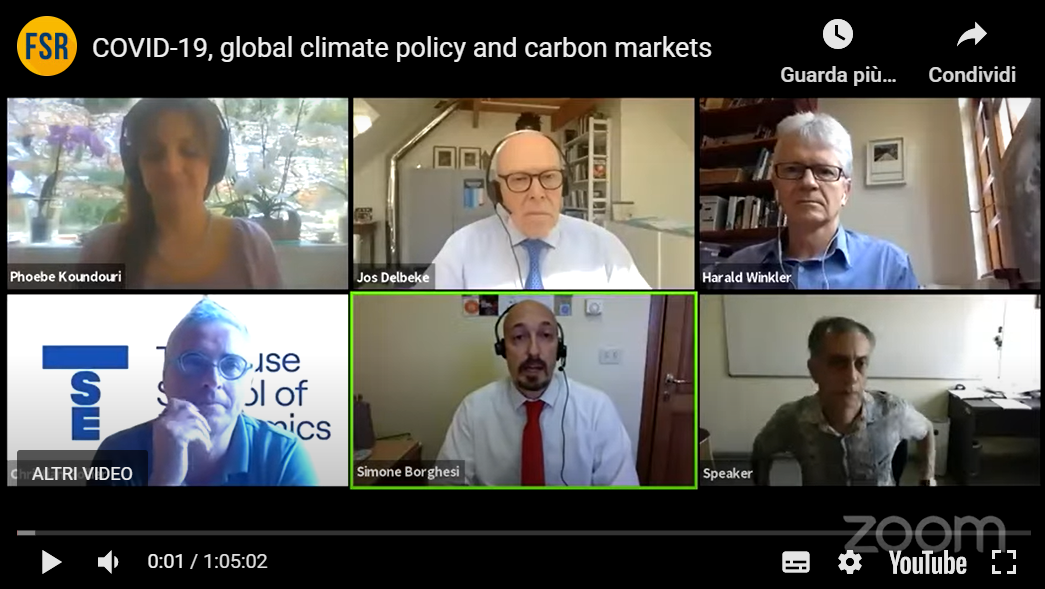
The victory of the Policy Outreach Committee of EAERE and FSR Climate was that of managing to organize in short time an online event on “COVID-19, global climate policy and carbon markets” which could replace the workshop that was originally planned for the State of the Union here in Florence. And the event turned out to be very successful both in terms of numbers of participants (388 attending the events and many visualizations on Youtube) and quality of the interventions. Each speaker enriched the debate with his/her own views bringing heterogeneous perspectives from all over the world and from different economic contexts.
As any memorable victory, there are backstage stories to tell. In this case, at least two of them (before and after the event) are worth mentioning.
Before the beginning of the live event we had to solve some technical issues which were complicated by the need to keep physical distance with my team members. As the problem could not be solved, I eventually had to run to another computer just two minutes before the live event started. No more time for thinking: sit down and go….I share with some of my team members an insane passion for basket and one of them wrote me: “That was a buzzer beater from your side, you entered the webinar cold as ice!”. I was actually melting for the running and the tension of not knowing how to solve the technical problem till the very end, but good that everything was successful in the end.
But the best part of the backstage stories came after the event. I was trapped in a long series of online meetings the whole afternoon. When I finally finished, I found lots of email exchanges among the speakers who continued to discuss, exchange documents and ideas until late at night. I found this simply amazing. It made my day to see how deeply involved all of them are in discussing possible solutions. This capability of provoking ideas and further debates is what makes an event really successful. It is particularly meaningful, in my view, because it shows the capacity of our LIFE project and of enthusiasm for research to win over the difficulties and deliver its results.
The fight versus COVID19 is a hard one and a long way is still to go. Some of us lost friends and relatives in this fight. But we know we can win if we stay distant but united. Well, our event was a little, still important, example of what we can do as a research community keeping distant but united.