EAERE at COP30 – Local climate finance for a just transition to carbon neutral and resilient cities
The 30th meeting of the Conference of the Parties (COP30) to the UN Framework Convention on Climate Change (UNFCCC) took place in Belém (Brazil) on November 10-21, 2025. EAERE participated in the COP30 official side event on “Local climate finance for a just transition to carbon neutral and resilient cities“. Co-organised with SUR Lab Bocconi University, Conseil des Communes et Régions d’Europe (CCRE / CEMR), and Polytechnic of Turin, the event was held on November 11, 2025 at 18:30 – 20:00 Local Time / 22:30 – 24:00 (CET) in Belém (Brazil).
Session report
The workshop explored how local climate finance can support a just transition toward carbon-neutral and resilient cities. Moderated by Edoardo Croci (Bocconi University, SUR Lab; Spoke 1, MUSA Scarl), the session discussed governance frameworks and innovative financial instruments that enable cities to implement ambitious climate actions. Through a series of case studies, speakers examined how subnational entities can mobilize resources, ensure fairness in carbon budgeting, and align multi-level policies for urban decarbonization.
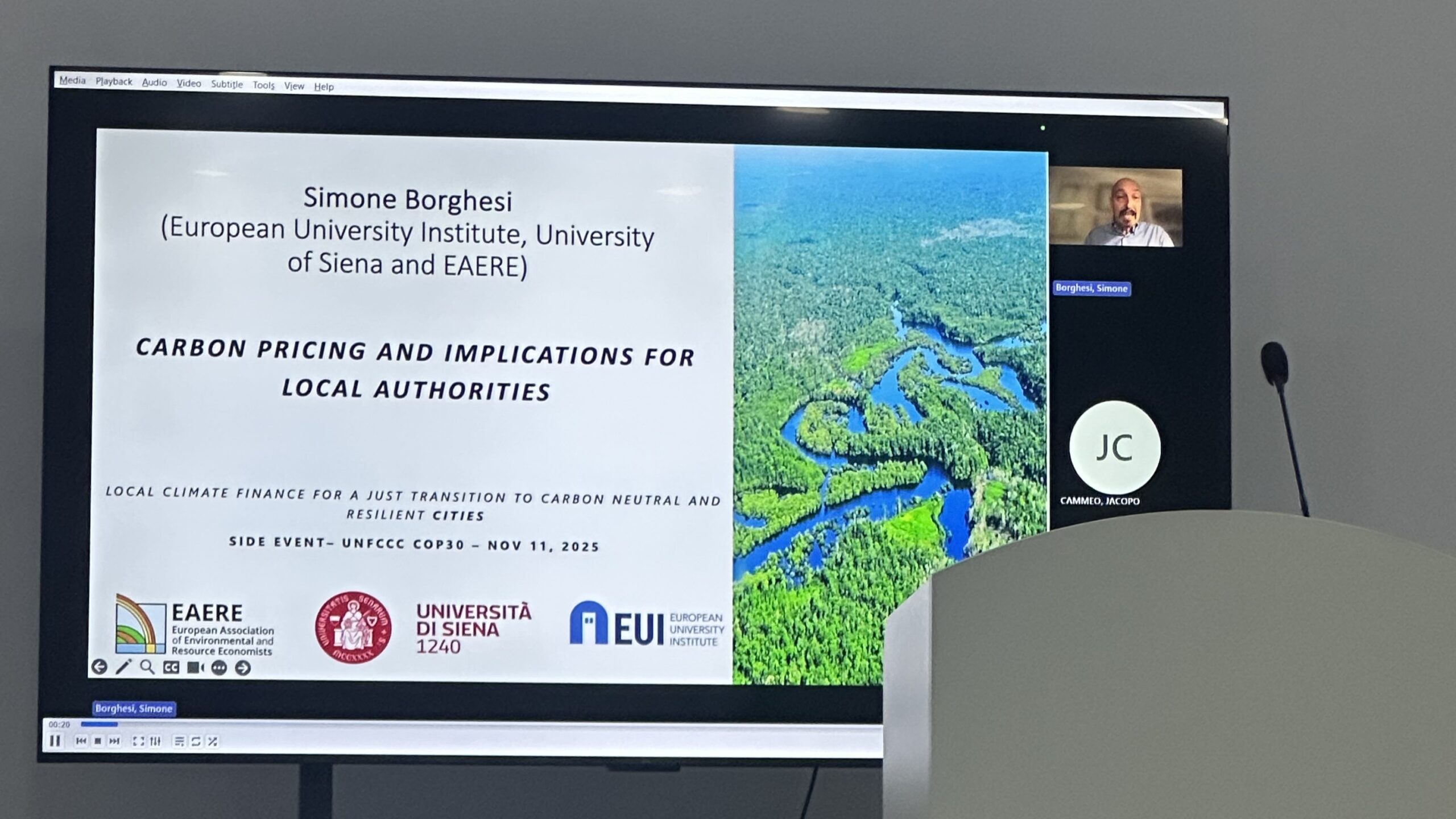
Simone Borghesi – EAERE / European University Institute / University of Siena
Simone Borghesi emphasized that cities account for around 70% of global CO₂ emissions and therefore play a pivotal role in achieving climate neutrality by 2050. Drawing on experiences from the province of Siena, certified in 2011 as one of the first carbon-neutral vast areas in the world, he illustrated how urban policies integrating emission-reduction targets, sustainable mobility, and responsible tourism can produce multiple benefits. He stressed the importance of carbon pricing and coherent multi-level governance, warning that local potential remains partly untapped due to fragmented regulations. He called for clear rules, bottom-up approaches, and greater financial empowerment of municipalities to translate symbolic commitments into effective action.
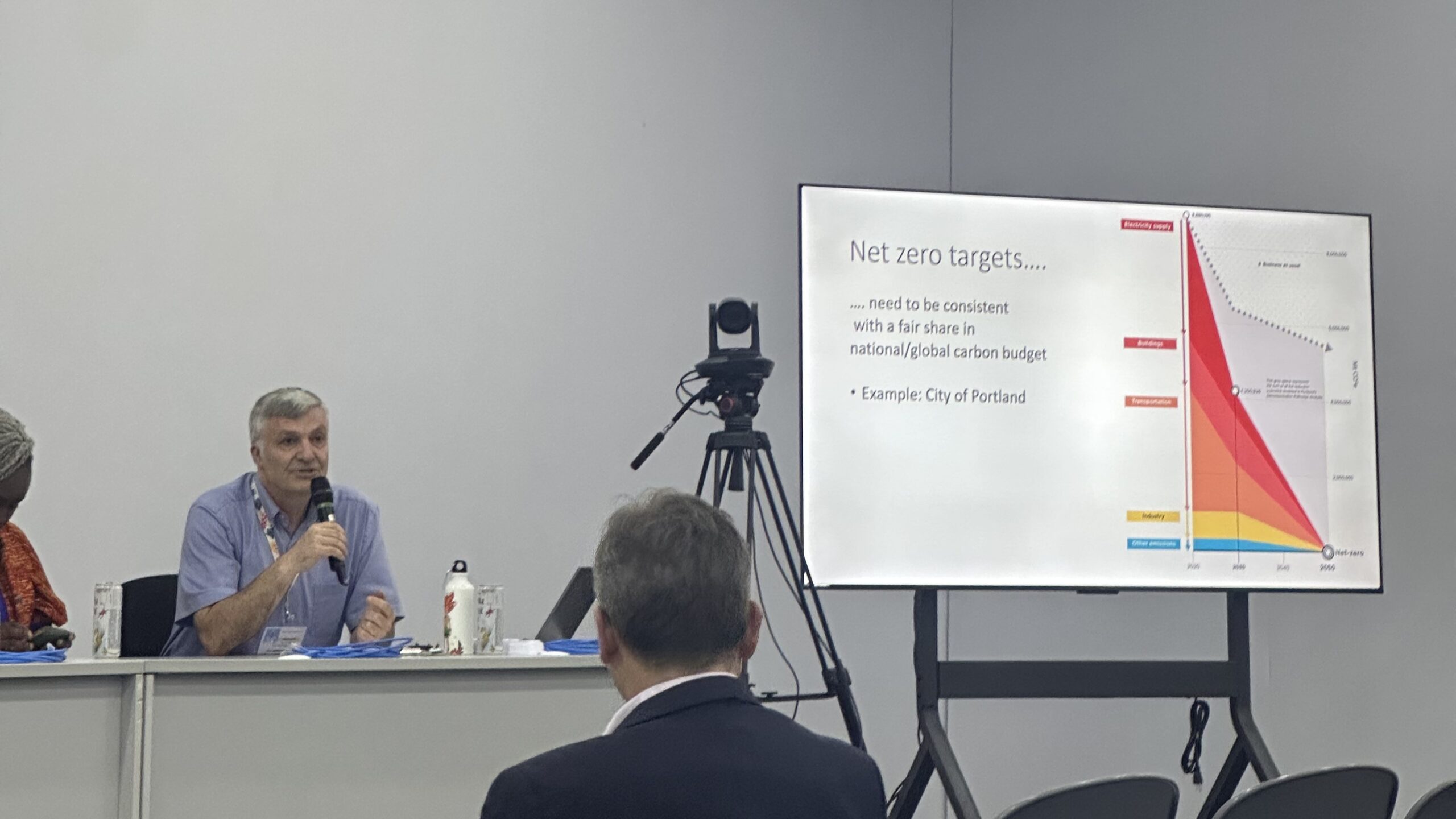
Karl Steininger – University of Graz
Karl Steininger addressed the challenge of allocating carbon budgets at the local scale, highlighting fairness as a key dimension for policy evaluation. While carbon budgets are traditionally defined at national level, cities increasingly set net-zero targets that must remain consistent with their “fair share” of national or global budgets. Presenting empirical results for EU cities, he proposed a flexible framework adaptable to different regulatory contexts where equity, wellbeing, and sufficiency thresholds should guide the distribution of mitigation efforts. Such an approach can inform financing strategies and ensure that urban transitions remain both equitable and consistent with broader climate goals.
Benedetta Lucchitta – SUR Lab Bocconi University
Benedetta Lucchitta examined two financial instruments suitable for Nature-Based Solutions (NBS) at the local level, focusing on their contribution to both mitigation and adaptation. NBS enhance urban resilience and wellbeing, yet their deployment often depends on payments for ecosystem services, voluntary or institutional schemes that compensate actors protecting natural assets. While typically designed at national level, these mechanisms can be implemented locally through ad hoc projects engaging municipal authorities and stakeholders. She highlighted the need to embed NBS financing within local governance frameworks, using Milan as an example of how urban ecosystems can be integrated into climate strategies.
Patrizia Lombardi – Polytechnic University of Turin
Patrizia Lombardi presented the Turin “Climate City Contract”, developed through a science-based and participatory approach led by the Polytechnic University of Turin. The platform collects data on both institutional and community-driven initiatives, enabling the monitoring of mitigation and adaptation actions. She underlined that scientific evidence and stakeholder collaboration are essential to manage urban complexity and ensure that data become “digestible” tools to guide decision-making.
Céline Papin – Vice Mayor of Bordeaux; AFCCRE and CUF
Céline Papin concluded by outlining key levers to finance local climate action: (1) large-scale investments to accelerate decarbonization over the next decade; (2) mobilization of all stakeholders through public-private partnerships and semi-public companies; (3) consistent measurement and monitoring using clear indicators. Her remarks emphasized that local financing must combine ambition, inclusivity, and accountability to drive effective urban transitions.
The session was interrupted for security reasons. Jane Lumumba, Programme Management Officer for Strategy and Climate Change at UN-HABITAT Regional Office for Africa, and Tadashi Matsumoto, Head of National Urban Policy and Climate Resilience Unit at OECD, did not have the chance to present.
Report by Cristina El Khoury (EAERE Communication Support Team).
Resources
Watch Simone Borghesi’s full speech here.
Access Karl W. Steininger’s slides here.