Supported Events

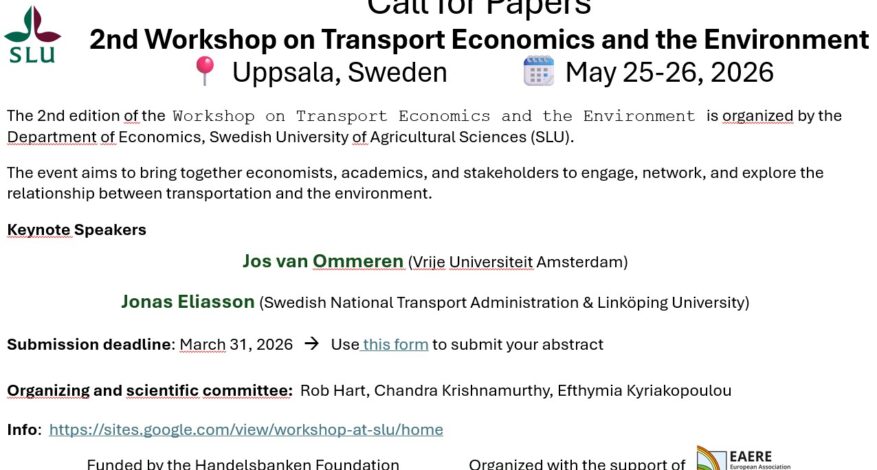
2nd Workshop on Transport Economics and the Environment

The 2nd Workshop on Transport Economics and the Environment will take place on May 25–26, 2026, at the Swedish University of Agricultural Sciences (SLU) in Uppsala, Sweden. The workshop is organized by the Department of Economics at SLU and is supported by EAERE.

The Workshop

The workshop aims to bring together economists, researchers, and stakeholders to engage, network, and explore the relationship between transportation and the environment. It provides an opportunity to present and discuss current research on the environmental impacts of transportation systems and the economic policies that can contribute to more sustainable mobility.

The event encourages collaboration and knowledge exchange among participants working at the intersection of transport economics, environmental policy, and sustainable transport systems.

Keynote Speakers

Call for Papers

Researchers are invited to submit papers for presentation at the workshop. Contributions addressing topics related to transport economics, environmental impacts of transport, and sustainable mobility policies are welcome.

Important Date

  • March 31, 2026 – Submission deadline

Organizing and Scientific Committee

Additional Information

For further details, including the full Call for Papers and submission information, please visit the workshop webpage

READ MORE
Supported Events

XXVII Annual BIOECON Conference


The Scientific Partners of BIOECON are pleased to announce the XXVII Annual BIOECON Conference, to be held on 7–8 September 2026 at St John’s College, Cambridge, United Kingdom.

Hosted by the Department of Land Economy and the Cambridge Centre for Environment, Energy and Natural Resource Governance (C-EENRG), University of Cambridge, and co-hosted with the German Centre for Integrative Biodiversity Research (iDiv) Halle-Jena-Leipzig, the Land Environment, Economics and Policy Institute (LEEP), and the Dragon Capital Chair in Biodiversity Economics at the University of Exeter Business School, the conference will bring together researchers and practitioners working at the intersection of biodiversity, economics, finance, and policy.

Keynote Speakers:

  • Jennifer Alix-Garcia (Oregon State University)
  • Robin Burgess (London School of Economics)

In addition to the conference theme noted above, BIOECON XXVII aims to have parallel sessions on a broad range of topics within the umbrella of biodiversity economics including: the role of biodiversity and ecosystem services in economic development, plant genetic resources and food security issues, deforestation and development, fisheries, institutions and instruments (e.g. Payments for Ecosystem Services), biodiversity finance, development and conservation, wildlife conservation and endangered species, international trade and regulation and climate change.

Call for Papers

Submissions are invited on the conference theme “Economics, Finance and Nature Based Risks”, as well as on a broad range of topics within biodiversity economics, including but not limited to:


  • Instruments for conservation in the context of land-use and biodiversity
  • Innovative financial mechanisms for conservation
  • Evaluation of biodiversity-related policies and programmes
  • Use of spatial data in biodiversity and conservation research
  • Conservation and valuation of crop genetic diversity
  • Institutional frameworks for resource conservation (property rights, market instruments, etc.)
  • Behavioural and experimental approaches to biodiversity policy design
  • Biodiversity finance, development and conservation
  • Interlinkages between climate change and biodiversity
  • Governance and management of natural resources in developing countries
  • Development, growth and resource constraints
  • Natural resource management, distribution and poverty alleviation
  • Experimental or survey research on biodiversity preferences and beliefs
  • Non-market valuation of biodiversity

Complete papers (including abstract, JEL codes and keywords) must be submitted via the dedicated submission portal by 24 April 2026. Only complete papers will be considered.

Notification of acceptance will be communicated by 25 May 2026.

It is also possible to submit proposals for special sessions (3–4 coordinated papers) under a common theme.


The Venue 

The Conference will be held at the historical premises of St. John’s College Cambridge. Accommodation and all meals will be provided in the College. The conference will open with a reception at St John’s College on the evening of Sunday the 6th of September 2026. Conference sessions will commence on the morning of Monday the 7th of September and conclude on the afternoon of Tuesday the 8th of September (by 5:00pm GMT). The conference banquet will take place at the main Dining Hall of St John’s College on the evening of the 7th of September. Delegates will also have privileged access to the renown grounds and Chapel of St. John’s (unless closed for building work).

Submissions

Complete papers may be submitted for presentation within the BIOECON Conference and only complete papers will be considered by the Scientific Programme Committee. Electronic copies should be sent using this dedicated submission page by clicking here no later than Friday 24th of April 2026. Please include Abstract, JEL Codes and Keywords with your submission. Acceptance of papers will be notified by email by Monday 25th of May 2026. If you wish to be considered for a bursary, please indicate this in the submission page. Applying for a bursary will not affect whether your paper is selected (indeed, the paper may be accepted even if we are unable to offer a bursary).
It is also possible to submit 3-4 papers together as a suggested “special session” under a theme similar to those indicated above. In this case, please send your proposal via email to bioecon@bioecon-network.orgt. The Scientific Partners reserve the right to accept papers on an individual basis, so it is possible that even when a session is not accepted, individual papers within the session might be so.

Registration

Paper-presenters attending the full event will be charged £320 that includes 2 night’s accommodation (on a B&B basis) on the 6th and 7th of September and all social events and meals at St. John’s College for the duration of the conference. Paper presenters will also have the option of attending the event as a day participants (not requiring overnight stay) for £115 (with the banquet) or £80 (without banquet). There will also be the option to attend the entire event as a non-paper presenter (pending availability) for a fee of £470 (includes 2 nights’ accommodation, social events and meals) or as a non-paper day participant for £170 (with banquet) or £120/day (without banquet). Bookings can be made on a dedicated conference porTal (to be accessed via the conference website here) and that will be made available in early June. Delegates will be able to book additional nights (subject to availability), upgrade to a double room (subject to availability) and pay for additional meal guests through the same portal.

All other questions regarding fees, registrations and accommodation should be sent to the conference secretariat at bioecon@bioecon-network.org.

The conference will be an entirely an in-person event. Virtual attendance or on-line presentation of one’s paper will not be possible.
There will be a limited number of bursaries made available which will allow some presenters to attend free of charge (though they will not cover travel to the conference or any visa fees). These will be directed towards PhD students and early career researchers, and particularly those who are based at institutions in the Global South and from transition and emerging economies. As noted above, please indicate in paper submission portal if you would like to apply for a bursary when submitting your paper.

Registration will open on Monday 1st of June 2026. Registration for all conference presenters is due by Friday 26th of June 2026. It may be possible for attendees who are not presenting to register later than this, but such places cannot be guaranteed. Registration for conference delegates not presenting will close on the 17th of July 2026. Further registration details and all other conference information will be provided on the BIOECON website here.

Further Information

Further registration details and all other conference information will be provided on the BIOECON website. For a flavour of previous BIOECON conferences visit this page.
All other questions regarding fees, registrations and accommodation should be sent to the conference secretariat at bioecon@bioecon-network.org.

Important Dates

  • 24 April 2026 – Submission deadline
  • 25 May 2026 – Notification of acceptance
  • 1 June 2026 – Registration open
  • 26 June 2026 – Registration deadline for paper presenters
  • 17 July 2026 – Registration deadline for all participants
  • 7–8 September 2026 – XXVII BIOECON Conference
READ MORE

JEEM / REE Workshop on Nonmarket Valuation


Post-Congress 2026 Workshop

The Journal of Environmental Economics and Management (JEEM) and Resource and Energy Economics (REE), in collaboration with the Faculty of Economics and Business at the University of the Basque Country and the Basque Centre for Climate Change (BC3), are delighted to announce a call for abstracts for the third joint Workshop on Nonmarket Valuation. Similar to the first two workshops held back-to-back to EAERE Conferences in 2024 and 2025, the third workshop will be staged following the 7th World Congress of Environmental and Resource Economists (WCERE).

While the WCERE will be held in Carcavelos, Portugal, 29 June – 3 July, the workshop itself will take place at the University of the Basque Country (UPV/EHU) in Bilbao, Spain, a short direct flight from Lisbon.

The workshop will consist of two full days of presentations, starting in the morning of July 6, and ending in the afternoon of July 7.

Deadline for abstract submission: 6 March 2026

Event webpage

READ MORE
Supported Events

14th Mannheim Conference on Energy and the Environment – MCEE 2026


ZEW Mannheim is pleased to announce the 14th Mannheim Conference on Energy and the Environment – MCEE 2026 to be held on May 19-20, 2026 at the ZEW – Leibniz Centre for European Economic Research in Mannheim (Germany). The Conference is supported by EAERE.

The Conference

The MCEE aims to promote the exchange of ideas among researchers at all career stages working in the fields of energy, climate, and environmental economics. Its parallel sessions enable a wide variety of topics and intensive discussions among researchers sharing similar interests. The conference provides an inclusive platform that bridges different methodological perspectives, featuring empirical analyses, theoretical work, behavioral approaches, and simulation modeling.

Keynote speakers

Call for papers

Interested researchers are invited to submit an academic paper. Extended abstracts (min. 1,000 words) are accepted. However, all else equal, preference will be given to completed papers.  Topics may cover, but are not limited to, the following economic fields:

  • Environmental economics
  • Energy economics
  • Climate economics
  • Public economics

Submissions should be uploaded to the conference submission portal no later than January 31, 2025.

Fees

The conference fee is EUR 290. This covers the conference materials, meals, refreshments, coffee breaks, and the conference dinner. Participants who present a paper will pay a reduced fee of EUR 240. PhD students (both presenting and non-presenting) pay a reduced fee of EUR 190. Presenters are asked to discuss a paper. Authors shall send their papers to the discussant at least two weeks before the start of the conference.

Important dates

January 31, 2026: Submission deadline
March 16, 2026: Notification of acceptance
April 12, 2026: Registration as presenter
May 3, 2026: Registration as participant only
May 19-20, 2026: Conference

Scientific committee

MCEE 2026 scientific committe’s members are Christoph Böhringer (University of Oldenburg, DE), Antoine Dechezleprêtre (OECD, FR), Eugenie Dugoua (London School of Economics, UK), Natalia Fabra (Fundación Centro de Estudios Monetarios y Financieros (CEMFI), ES), Massimo Filippini (ETH Zürich, CH), Gautam Gowrisankaran(Columbia University, US), Kathrine von Graevenitz (ZEW and University of Mannheim, DE), Martin Kesternich (University of Paderborn, DE), Andreas Lange (University of Hamburg, DE), Matti Liski (Aalto University, FI), Andreas Löschel (Ruhr-University Bochum, DE), Erica Myers (University of Calgary, CA), Sebastian Rausch (ZEW and University of Heidelberg, DE), Oliver Schenker (ZEW Mannheim, DE), Ulrich Wagner (University of Mannheim, DE) and Frank Wolak (Stanford University, US).

Organisers

MCEE 2025 organisers are Sebastian Rausch (ZEW Mannheim and University of Heidelberg), Kathrine von Graevenitz (ZEW Mannheim and University of Mannheim) and Oliver Schenker (ZEW Mannheim).

Additional information

Contact mcee2026@zew.de for any further information, and visit the Conference’s webpage for more information.

READ MORE
Supported Events

Winter School: Assessing Economic Policies Using the Real Options Methodology


The Wageningen School of Social Sciences (WASS) and the Agricultural Economics and Rural Policy Group (AEP) are glad to announce the Winter School on “Assessing Economic Policies Using the Real Options Methodology” to be held on February 2-6, 2026 in Wageningen (the Netherlands). The course is supported by EAERE.

The course

This course will address the issue of irreversibility from an economic point of view. Different approaches dealing with irreversibilities have emerged in the economic literature. The two most prominent once are the quasi option and real option value theory. Application of both approaches requires technical skills most students find difficult. The objective of the course is to introduce the origins of the quasi option value and real option values, to teach the methods most commonly used (discrete methods such as decision trees; continuous time, continuous state models using stochastic processes; Itó calculus), and to discuss and practice various applications including non-renewable resource use, technology adoption, climate change, forestry, and food- and bio-safety. The course will include two parts. One week of lectures and exercises with assignments and a course paper. For passing the course students need to participate in lectures and exercises (min. 90%) and submit the course paper within six month after the course.

Lecturers

Learning outcomes

After successful completion participants are expected to be able to:

  • Know the economic implications and relevance of the irreversibility effect;
  • Understand economic papers that apply real option models;
  • Apply discrete state models for decision under uncertainty and irreversibility;
  • Know the steps from discrete time, discrete state to continuous time, continuous stat models;
  • Develop real option models and anlyse the results using numerical simulation methods.

Registration

The course is designed for PhD candidates. Min. 10 participants, max. 25 participants. You can register here, selecting the course name.  Deadline for registration is set on December 31, 2025.

More information

Details, course fees and schedule are available on the course’s web page.

READ MORE
Supported Events

EMEE 2026 – 17th International workshop on Empirical Methods in Energy Economics


The Environment Centre and the Institute of Economic Studies of Charles University are pleased to announce the 17th International Workshop on “Empirical Methods in Energy Economics” – EMEE 2026 to be held on January 22-23, 2026 at Charles University in Prague (Czech Republic). The event is supported by EAERE.

The workshop

The workshop continues the long-standing tradition of EMEE meetings, serving as a forum for the presentation and discussion of innovative empirical research in energy economics. The event will bring together researchers who apply advanced econometric methods, utilise original datasets, and employ rigorous study designs to address key issues in energy and environmental policy.

Programme and format

The format of the 2026 workshop will consist of plenary presentations (i.e., no concurrent sessions), followed by brief discussions, egg-timer sessions, and poster sessions. Overall, the scientific committee will select approximately 30 papers.

The papers and posters for the 2026 workshop will be selected based on extended abstracts (3 -5 pages) structured as follows: 1) overview, 2) methods, 3) data, and 4) preliminary results.

Call for contributions

The EMEE 2026 conference particularly welcomes submissions in the areas of Experimental and quasi-experimental design, panel data, structural econometrics, and Energy and development. The deadline for submitting the extended abstracts (in PDF format) is November 25, 2025.

The Scientific Committee will review the abstracts, with acceptance decisions notified by December 10, 2025. The extended abstract should be attached as a PDF file to an email sent to the workshop address (emee2026@czp.cuni.cz). Please write “EMEE paper submission”. Registration for the workshop will be possible in December 2025.

Final papers/presentations, which will be available on the conference website, must be submitted by January 20, 2026.

Important dates

November 25, 2025 – Deadline for extended abstracts
December 10, 2025 – Notification of acceptance
December 2025 – Registration for the workshop
January 20, 2026 – Submission of final papers/presentations
January 22–23, 2026 – Conference

The venue

The conference will take place at Charles University in Prague (Czech Republic) at the premises of The Institute of Economic Studies at the Faculty of Sciences (Thursday) and the Rectorate building (Friday). For accepted participants, further details will follow.

Scientific committee

EMEE 2026 scientific committe’s members are Anna Alberini (University of Maryland, USA), Antonio Bento (University of Southern California, USA), Davide Cerruti (Vienna University of Economics and Business, Austria), Cloè Garnache (Oslo Metropolitan University and CEPE ETH Zurich), Massimo Filippini (CEPE, ETH Zurich and USI, Switzerland), Todd Gerarden (Cornell University, USA), Ken Gillingham (Yale University, USA), Sébastien Houde (Faculty of Business and Economics Lausanne, Switzerland), Li Jing (Tufts University, USA), Reinhard Madlener (RWTH Aachen University, Germany), Lucija Muehlenbachs (University of Calgary, Canada), Erich Muehlegger (University of California Davis, USA), David Rapson (University of California Davis, USA), Milan Scasny (Charles University, Czech Republic), Joachim Schleich (Grenoble Ecole de Management, France), Ulrich Wagner (Uni Mannheim, Germany), Shuang Zhang (Imperial College, UK), Jevgenijs Steinbuks (World Bank Group, USA).

Local organiser

EMEE 2026 local organiser is Milan Ščasný (Charles University, Czech Republic).

Additional information

EMEE annual workshops have been organised since 2008. Details on previous workshops and information about joining the EMEE Network can be found on the EMEE network webpage.

Please send all queries to the workshop address (emee2026@czp.cuni.cz). Further information can be found on the workshop’s website.

READ MORE
Supported Events

2026 Conference on Sustainable Resource Use and Economic Dynamics – SURED


The 2026 Monte Verità Conference on Sustainable Resource Use and Economic Dynamics – SURED will be held from 31 May to 4 June 2026 on Monte Verità in Ascona (Switzerland).

SURED conferences

The SURED conferences have become well-known events in the fields of resource, energy and environmental economics and dynamic economic theory. By bringing together leading experts and young scientists from different disciplines and countries, SURED 2026 will provide a forum for the discussion of the latest developments in the field and for identifying future research agendas. SURED takes place every two years on Monte Verità in Ascona.

Concept note

Governments are increasingly using industrial policy to address the transition to a low-carbon economy. Such policy aims to transform the structure of the economy by providing support to specific industries, companies or technologies, and to secure and reshape global value chains for critical materials. The recent surge of industrial policy as a tool to achieve the clean energy transition is thus highly relevant for the field of environmental economics when it comes to making policy-relevant recommendations. While economic theory has long criticized industrial policy on the ground of coordination failures and advocated carbon pricing instead as the main policy, there is a need for more systematic theoretical and empirical analysis about the benefits and costs of such policies.

SURED 2026 will provide an opportunity to present and discuss the latest research in this area, and more generally in the area of climate policy. It will explore how economic policy can limit the most severe adverse impacts and identify potential opportunities that will help map a path forward into a sustainable future.

Keynote speakers

Call for papers

The call for paper is available on the Conference’s website.

Organising Committee

Beat Hintermann, University of Basel
Joëlle Noailly, Geneva Graduate Institute & VU Amsterdam
Sjak Smulders, Tilburg University
Christa Brunnschweiler, University of East Anglia
Corrado Di Maria, University of East Anglia

More information

Details about the Conference will be shared in due time. To stay updated please visit the Conference’s website. For additional information contact sured@unibas.ch.

READ MORE
Supported Events

14th IAERE Annual Conference – IAERE 2026


The Italian Association of Environmental and Resource Economists – IAERE is glad to announce its 14th Annual Conference, which will be hosted by the Department of Economics and Management (DEM) and the School of International Studies (SIS) of the University of Trento, on February 12-13, 2026.

The conference will feature two distinguished keynote speakers: Antoine Dechezleprêtre (OECD)  and Namrata Kala (MIT Sloan). In addition to the plenary sessions, the programme will include a wide range of parallel sessions covering frontier research and policy-relevant topics in the field of environmental and resource economics.

The call for papers is open until October 13, 2025.

Visit the Conference’s website at https://www.geniusec.it/iaere-annual-conference-2026

READ MORE
Supported Events

IAERE School ” Input Output Analysis for Environmental and Resource Economics”


The Department of Economics, Society, Politics of the University of Urbino Carlo BoIUSS Pavia and the Italian Association of Environmental and Resource Economists (IAERE) are delighted to announce the 9th edition of the IAERE School on ” Input Output Analysis for Environmental and Resource Economics”. The School will be held on 14-17 October 2025 at Palazzo Passionei in Urbino (Italy).

The School

Input-output analysis is one of the most widely applied methods to evaluate the link between the economy and the environment accounting for the inter-dependency of industries and countries. Developed by Wassily Leontief (Nobel Prize in Economics 1973) in the 1930s, input-output analysis has recently regained the attention of the academic community and policy makers for the evaluation of the environmental and soc io-economic consequences of trade and structural change.

The aim of the course is twofold. The course intends to introduce the basics of input-output analysis, with both theoretical and practical lectures on applications to environment-related issues. Recent developments, extensions and applications of input-output analysis for the study of environment-related issues will be presented and discussed.

  • Foundations of input-output and national accounting
  • The Leontief model
  • Environmentally Extended Input-Output Analysis: theory and applications
  • Multi-regional input output analysis
  • Structural decomposition analysis for environmental and resource economics
  • Overview of existing input-output databases
  • Input-output to analyse extreme events
  • I-O and network analysis

The Schedule

The programme of the School will consist of four days (Tuesday morning to Friday afternoon) of teaching by prominent academics. The School will also offer the opportunity to students to present a research proposal. The best proposal will be awarded with the IAERE Visiting PhD Scholarship.

The School will be organized in 12 teaching modules and 4 discussion sessions:

  • 9:30-11:00 Teaching module
  • 11:00-11:30 Coffee break
  • 11:30-13:00 Teaching module
  • 13:00-14:30 Light lunch
  • 14:30-16:00 Teaching module
  • 16:00-16:30 Discussion

Faculty

Faculty members are Alessandro Caiani (IUSS Pavia), Erik Dietzenbacher (University of Groningen), Jlenia Di Noia (IUSS Pavia), Tiziano Distefano (University of Firenze), Carolyn Fischer (Development Research Group, The World Bank), Leonardo Niccolò Ialongo (Complexity Science Hub) and Giovanni Marin (University of Urbino ‘Carlo Bo’).

Registration and participation fees

The minimum number of students for the activation of the program in person is 15. The maximum number is 30. Participation to School will be in person.

Registration to the School is reserved for IAERE Members. Participants who are not yet IAERE members will be kindly requested to register for IAERE Membership.

Participation fees are the following:

  • Students: EUR 100
  • IAERE members: EUR 450

The registration fee includes the course material, participation diploma, coffee breaks and light lunches included in the School programme, one social dinner. Accommodation is not included.

Online application is available here.

Organisers

The Conference is organised by the Department of Economics, Society, Politics of the University of Urbino Carlo Bo and by IUSS Pavia. The event is supported by EAERE.

Important Dates

19 September 2025 – Deadline for applications
23 September 2025 – Acceptance notifications
29 September 2025 – Deadline for registration
14-17 October 2025 – IAERE School

Further information

School’s website: https://www.iaere.org/iaere-summer-school

For more information, please contact iaere@iaere.org.

READ MORE
Supported Events

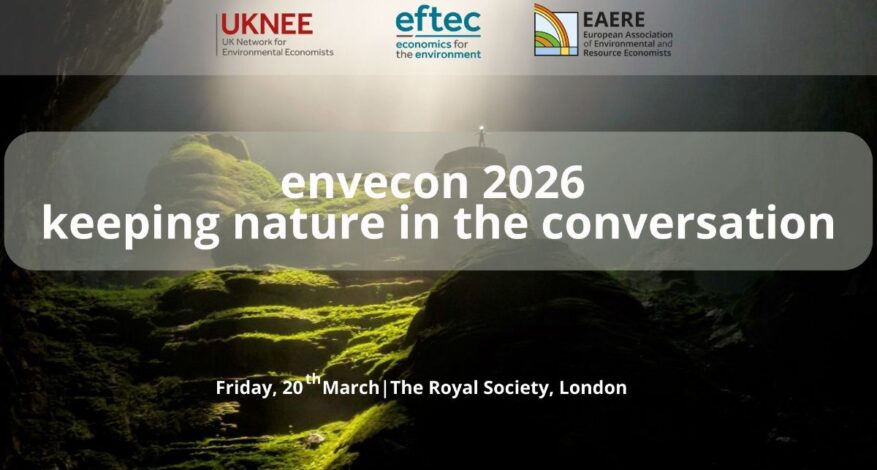
envecon 2026

The UK Network for Environmental Economists – UKNEE is glad to announce its next annual applied environmental economics conference, envecon,  to be held on March 20, 2026 at The Royal Society in London (UK).

envecon 2026 Agenda

🕘 09:30 – 10:00 | Keynote Speaker

Professor Anjali Goswami — Chief Scientific Adviser & Director-General Science, Data and Analysis at the UK Department for Environment, Food and Rural Affairs.

🕙 10:00 – 11:10 | Session 1: Professor Ken Willis Session on Next Frontier in Economic Valuation: Biodiversity
Chair: Prof Kate Jones (UCL)

🕚 11:25 – 12:50 | Session 2: Professor David Pearce Session on Economics for Environmental Policy
Chair: Assoc Prof Marije Schaafsma (IVM, Amsterdam)

🕜 13:40 – 14:40 | Session 3: Net Zero for Agriculture: Behavioural and Economic Levers for a Just Transition
Chair: Dr Sanchayan Banarjee (King’s College London)

🕞 14:40 – 15:40 | Session 4: Nature in Conversation with Other Policy Areas
Chair: Dr James MacGregor (Lifescape Project)

🕓 16:00 – 17:00 | Session 5: Bridging the Divide: Routes to Land Economic Messages in Westminster

Masterclass by Matthew Browne, Head of Public Affairs, The Wildlife Trusts — practical insights and group activities on communicating economic evidence to policymakers.

📍 Poster Session (timing interleaved/throughout)

Registration is now open – book your tickets here


More information

Discover more about envecon past editions at https://www.uknee.org.uk/envecon.

For more information, please contact uknee@uknee.org.uk.

READ MORE