Policy Outreach Events

Fifth CEPR/EAERE Webinar on Climate Policy: The Transition to Net Zero by 2050

The number of countries announcing pledges to achieve net-zero emissions over the coming decades continues to grow. But the pledges by governments to date – even if fully achieved – fall well short of what is required to bring global energy-related carbon dioxide emissions to net zero by 2050 and give the world an even chance of limiting the global temperature rise to 1.5 °C. The International Energy Agency recently published a comprehensive study of how to transition to a net zero energy system by 2050 while ensuring stable and affordable energy supplies, providing universal energy access, and enabling robust economic growth. The study sets out a cost-effective and economically productive pathway, resulting in a clean, dynamic and resilient energy economy dominated by renewables like solar and wind instead of fossil fuels. It also examines key uncertainties, such as the roles of bioenergy, carbon capture and behavioural changes in reaching net zero. The webinar will be the occasion to discuss the content of IEA Report on NetZeroby2050 with Laura Cozzi, IEA Chief Energy Modeller, who led the writing team.

Join us on Thursday October 28, 2021 from 5:00 to 6:30pm CET to hear from Laura Cozzi (International Energy Agency). Her presentation will be followed by a discussion by Carlo Carraro (Ca’ Foscari University of Venice, CMCC and CEPR) and a Q&A session with the audience.

Register here!

Detailed programme is available here

READ MORE
Policy Outreach Events

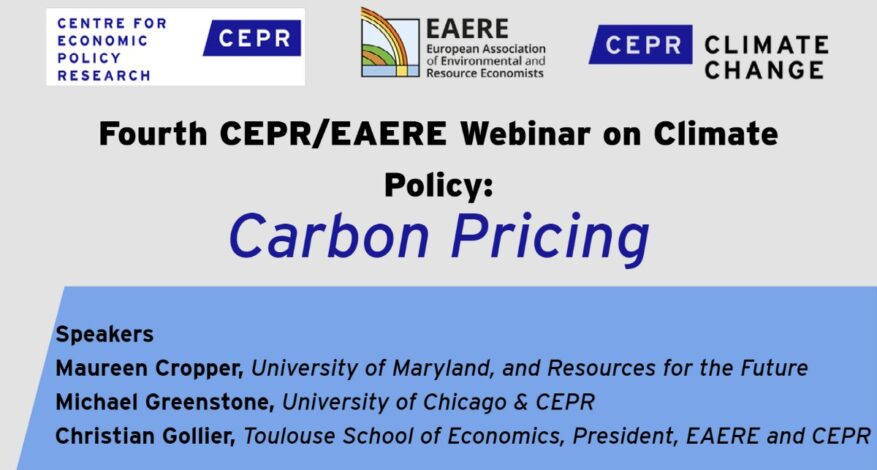
Fourth CEPR/EAERE Webinar on Climate Policy: Carbon Pricing

Carbon pricing is useful to induce all GHG emitters to internalize the climate damages associated to their emissions. But even in countries without a market pricing mechanism, it is important to value carbon in order to perform the socio-economic evaluation of the myriad of climate policies that will have to be implemented to attain their emission target. During this webinar, three panelists will summarize their findings about what carbon price/value should be recommended, or about the rate at which this carbon value should grow over time. The panelists will also identify the sources of uncertainty and of scientific disagreement surrounding this economic approach to fighting climate change.

Join us on Thursday September 30, 2021 from 5:00 to 6:30pm CEST to hear presentations from:

– Christian Gollier, President, EAERE, Executive Director, Toulouse School of Economics, and Research Fellow, CEPR
– Maureen Cropper, Professor of economics, University of Maryland, and Senior fellow, Resources for the Future
– Michael Greenstone, Milton Friedman Distinguished Service Professor in Economics, University of Chicago and Research Fellow, CEPR

Their 20-minute presentations will be followed by a 25-minute open discussion & Q&A session.

Register here

Video recording here

READ MORE
Policy Outreach Events

Third CEPR/EAERE Webinar on Climate Policy: The European Green Deal

We are delighted to invite you to the Third CEPR/EAERE Webinar on Climate Policy: The European Green Deal, taking place on Friday 16 July 2021, 17:00 – 18:30 CEST.

On July 14, 2021 the European Commission will present its “Fit for 55” Proposal. In this online event, Stefanie Hiesinger, Member of Cabinet of the Executive Vice-President for the European Green Deal, and Frans Timmermans at the European Commission, will introduce us to the key insights of this proposal. Their comments will be followed by a description of his perspective by Peter Liese as Member of the European Parliament and a commentary by Arthur Runge-Metzger, Director for Climate Strategy, Governance, Emissions from Non-Trading Sectors at the European Commission’s Directorate General for Climate Action. Finally, Ottmar Edenhofer, EAERE POC member and Director of the Potsdam-Institute for Climate Impact Research (PIK), will share his views on a whole economy carbon price for Europe and how this goal can be reached. The event will be moderated by Brigitte Knopf, Secretary General of the Mercator Research Institute on Global Commons and Climate Change (MCC).

Detailed programme:

17:00 – 17: 05 – Introduction by Ottmar Edenhofer (Potsdam Institute for Climate Impact Research and CEPR)
17:05 – 17: 25 – Presentation on the EU Commission’s Proposal: Focus on ETS and Energy Taxes Stefanie Hiesinger (European Commission)
17:25 – 17:45 – Commentary & Insights Peter Liese (European Parliament), Artur Runge-Metzger (European Commission), Ottmar Edenhofer (Potsdam Institute for Climate Impact Research and CEPR)
17:45 – 18:30 – Moderated Discussion with Brigitte Knopf (Mercator Research Institute on Global Commons and Climate Change)

Register here

VIEW THE VIDEO RECORDING HERE

Organisers:

Carlo Carraro (Università Ca’ Foscari di Venezia and CEPR)
Ottmar Edenhofer (EAERE POC and Potsdam Institute for Climate Impact Research)
Christian Gollier (Toulouse School of Economics and CEPR)

The Climate Policy Webinar Series (CPWS) is a webinar series featuring invited speakers in the area of climate policy. It is aimed at experts working in governments, international organizations, the private sector, academics and the media. This monthly online series started in May 2021 and is organized jointly by the Centre for Economic Policy Research (CEPR) and the European Association of Environmental and Resource Economists (EAERE).

READ MORE
Policy Outreach Events

Second CEPR/EAERE webinar on Climate Policy: Pandemic stimulus spending and the fight against climate change

Second CEPR/EAERE webinar on Climate Policy:  Pandemic stimulus spending and the fight against climate change will be held on June 10th, 5.00-6.30 pm CEST.

Climate change is a long term threat to human societies with expected huge impacts on health, economies and welfare. Somehow similar to a pandemic, but with more persistent and irreversible consequences. Even more than the fight against Covid-19, climate change control is a difficult and complex task, which requires well-designed policies and important financial resources.
The post-pandemic recovery is an important opportunity, if policies to address the current pandemic are and will be designed to achieve stronger, sustainable, and low carbon economic growth.
The Covid-19 pandemic has indeed triggered the deepest global economic contraction since World War II. While most economies are expected to rebound in 2021-2022, the impact of the pandemic on many aspects of economy and emission drivers may last far longer. Therefore, a strong alignment of Covid-19 recovery packages with climate targets has the potential to address two important objectives: economic recovery and decarbonisation. This webinar will analyse these issues starting from lessons from past pandemics and then focusing on the implications of recovery plans for the fight against climate change.

Programme:

Massimo Tavoni, Director of the European Institute on Environmental Economics (EIEE)
“In and out of pandemics: sustainability lessons from the recent past”
https://www.eiee.org/team-member/massimo-tavoni/

Ioana Petrescu, Senior fellow at the Mossavar-Rahmani Center for Business and Government at the Harvard Kennedy School and a former Romanian finance Minister
“Pandemic Stimulus Spending. A Glimpse into the (Green and Digital) Future”
https://ash.harvard.edu/people/ioana-petrescu

Moderated Discussion with:
Andrea Tilche, adjunct Professor at NTNU in Trondheim and former Director of the Environment Directorate of DG Research & Innovation
( https://ec.europa.eu/environment/archives/greenweek2013/andrea-tilche.html )
Danielle Arostegui, EDF Senior Analyst of Climate Policy
( https://www.edf.org/people/danielle-arostegui)

15-min Q&A session

Organisers:

Carlo Carraro (Università Ca’ Foscari di Venezia and CEPR)
Ottmar Edenhofer (Potsdam Institute for Climate Impact Research)
Christian Gollier (Toulouse School of Economics and CEPR)

WATCH THE VIDEO

Register here

Detailed programme here

The Climate Policy Webinar Series (CPWS) is a webinar series featuring invited speakers in the area of climate policy. It is aimed at experts working in governments, international organizations, the private sector, academics and the media. This monthly online series started in May 2021 and is organized jointly by the Centre for Economic Policy Research (CEPR) and the European Association of Environmental and Resource Economists (EAERE).

READ MORE
Policy Outreach Events

First CEPR/EAERE webinar on Climate Policy: The Carbon Border Adjustment Mechanism

The Climate Policy Webinar Series (CPWS) is a webinar series featuring invited speakers in the area of climate policy. It is aimed at experts working in governments, international organizations, the private sector, academics and the media. It runs online on a monthly basis starting in May 2021 and is organized jointly by the Centre for Economic Policy Research (CEPR) and the European Association of Environmental and Resource Economists (EAERE).

The first three events will be devoted respectively to the Carbon Border Adjustment Mechanism (CBAM), the EU Green Deal, and the EU recovery plan.

More precisely, the first event on the CBAM will take place on May 7, 2021 from 5.00 to 6.30 pm CEST. There will be three presentations of 25 minutes each, respectively by:

These presentations will be followed by a 15-minute debate moderated by Christian Gollier (Toulouse School of Economics, EAERE and CEPR).

The EU Parliament has recently proposed a framework for a carbon border adjustment mechanism (CBAM), which would be an extension of the ETS, requiring importers to purchase allowances for the volume of carbon emissions incorporated in their products. Carolyn Fischer,  Samuel Kortum and David Weisbach will explore the economic and political issues associated with this proposal aimed at leveling the playing field and at fighting the carbon leakage inherent to the renewed EU ambition on climate change.

Agenda

L. GARICANO’S PRESENTATION

S. KORTUM’S PRESENTATION

C. FISCHER’S PRESENTATION

READ MORE
Policy Outreach Events

EU, China & US on their way to carbon neutrality: will their implementation strategies converge?


Modern societies face many global challenges. Climate change is certainly among the most urgent and important ones. Europe has decided to address the widely diffused concern of public opinion on the effects of climate change by committing to reaching climate neutrality by 2050, an ambitious target that remains a top priority for the Von der Leyen Commission despite the difficulties raised by the COVID-19 crisis. Similar climate neutrality targets have been recently set by other jurisdictions, most notably the USA and China (the latter by 2060). The European Union can (and actually intends) to play a key leading role as regulator, negotiator and actor in the global climate challenge. While a unilateral European action will not be sufficient per se to stop global warming (as European emissions are only a relatively small part of total greenhouse gas emissions), the EU can lead the world by example in adopting more stringent climate regulations and hence influencing the others’ climate policies.

However, alternative climate policies and regulatory models might emerge at the world level possibly challenging the European leadership in the fight against climate change. Consider, for instance, the case of the European Emission Trading System (EU ETS). As it is frequently argued, the EU ETS represented a prototype for most other ETSs that have been rapidly emerging in the world. But ETSs might progressively diverge over time rather than converge towards a unique model to account for the different institutional frameworks characterising different jurisdictions. The same applies to other European climate measures and policies that might or might not fit other institutional contexts.

This raises some of the questions that will be addressed in the session, namely:

  1. What are the lessons that other jurisdictions can take from the European climate policy experience? Can/should the European experience with climate regulation be replicated in non-European contexts? If so, how? If not, why?
  2. How can other economies improve upon the European experience and how can Europe learn from others?
  3. Will the climate neutrality implementation strategies converge or diverge across different countries?
  4. Which policies will lead EU, US and China -the three main players in the global climate arena- towards the net-zero emissions target?
  5. What will be the impact of the Biden administration on international cooperation and climate policy in the years to come?
  6. Can international cooperation among Emission Trading Systems contribute to promoting a global climate policy?

EAERE Policy Outreach Committee together with FSR Climate  and in collaboration with the School of Transnational Governance of the EUI, organise this session to promote a more integrated dialogue between academia and policy world, providing advice and support to EU policy makers and institutions in designing policy interventions.

The event builds upon the successful experience of policy debates organized by FSR Climate at State of the Union since 2018 and intends to continue the policy dialogue carried out by FSR Climate under the ongoing LIFE DICET (Deepening International Cooperation on Emissions Trading) project. The project LIFE DICET focuses on the international carbon market cooperation between the EC and the regulators of other major ETSs, namely, California-Quebec, China, Switzerland and New Zealand and intends to support EU and Member State policymakers in deepening international cooperation for the development and possible integration of carbon markets at the world level.

The event chaired by Simone Borghesi (EAERE POC Secretary General) and Jos Delbeke (EAERE POC Chairman) is intended to address an audience of high-level policy makers, stakeholders and scholars such as those attending the SoU.

Website

Livestream

VIDEO RECORDING

READ MORE
Policy Outreach Events

The European Green Deal: prospects and challenges for the future – Keynote Plenary at EAERE2020

Time: 10:45-12:15
All information here

The session organized by the EAERE Policy Outreach Committee (POC) as part of the EAERE Plenary intends to discuss the features of the European Green Deal in the framework of the post-Covid policies. The EU has decided to green its new overall economic policy: priority is being given to climate neutrality by 2050, to biodiversity, the circular economy, and greening will be pursued in well established sectoral policies such as on energy, transport, innovation, agriculture, as well as on its budget and finance. The Covid reality has suddenly but profoundly changed the social, economic and political reality all over Europe. The heart of this discussion is the European budget and the Recovery Fund. The POC session will discuss to what extent the world looks different after several months of living with the Covid virus, from a perspective of reaching the climate targets, but even more importantly from the viewpoint of realizing the political ambition of the EU Green Deal. In line with the aim of the EAERE POC, particular attention will be devoted to the most suitable policies that should be implemented for an effective Green Deal and to the kinds of investments that are needed for the EU Green Deal to achieve its goals.

Organizers: Simone Borghesi, European University Institute; Jos Delbeke, European University Institute, KU Leuven


Chairs: Simone Borghesi, European University Institute, University of Siena; Jos Delbeke, European University Institute, KU Leuven


Keynote speakers:
Alexander Stubb, Director and Professor, School of Transnational Governance, European University Institute. Former Prime, Finance and Foreign Minister of Finland.
Peter Vis, Senior Adviser at Rud Pedersen Public Affairs, Brussels; Former official at the European Commission

Panelists: Thomas Sterner, EfD Environment for Development initiative, University of Gothenburg;
Herman Vollebergh, Tilburg University and Netherlands Environmental Assessment Agency;
Phoebe Koundouri, Athens University of Economics and Business;
Ben Groom, Department of Geography and Environment, London School of Economics and and Political Science;
Andrea Tilche, Directorate General for Research and Innovation, European Commission;
Dominique Bureau, General Delegate of the Economic council for sustainable development, Ministry of Ecology, Sustainable Development and Energy, France;
Aldo Ravazzi Douvan, Italian Ministry of Environment – Sogesid TA – OECD/WPEP – GBE – University of Roma Tor Vergata;
Xavier Labandeira Villot, Universidade de Vigo;
Ottmar Edenhofer, Potsdam Institute for Climate Impact Research (PIK), Mercator Research Institute on Global Commons and Climate Change, Technische Universität Berlin
READ MORE
Policy Outreach Events

COVID-19, global climate policy and carbon markets: expected impacts and possible solutions

The COVID-19 pandemic is having a dramatic impact on economic activities worldwide. This has both direct and indirect effects on greenhouse gas emissions and global warming. On the one hand, the fall in production and traffic volumes drastically reduces emissions, as it has already been observed after a few weeks of lockdown in a growing number of countries. On the other hand, the deep economic recession which might affect the world economy in the next years is likely to slow down the technological progress that is needed to progress along a low-carbon economic path. Moreover, the economic depression obviously has a large impact also on carbon markets: the fall in production brings about a sharp decrease in the demand of emission allowances, which causes a reduction in the allowance prices and thus also -ceteris paribus- in the incentive to invest in clean technologies.

For these reasons, it appears particularly important to identify in advance a suitable economic-climate package which may relaunch clean investments when economic activities will resume and avoid that the economic downturn may be followed by a sharp growth in emissions when the pandemic will be gone.

This raises some of the questions that we would like to address in this online debate, namely:

  1. What economic and climate policy package will be needed to deal with the economic consequences of COVID-19?
  2. How will the current emergency affect the European Green Deal?
  3. What consequences the ongoing pandemic may have on the EU ETS? What are its expected effects on the other Emission Trading Systems worldwide?
  4. What impact COVID-19 might have on international cooperation among Emission Trading Systems?
  5. What lessons can be learnt from the current pandemic for cooperation among countries in the international climate policy?

FSR Climate, in collaboration with the Policy Outreach Committee of EAERE (European Association of Environmental and Resource Economists), organises this online event to promote a more integrated dialogue between academia and policy world, providing advice and support to EU policy makers and institutions in designing policy interventions, which is particularly needed and urgent in these difficult times.

The event builds upon the successful experience of policy debates organized by FSR Climate at State of the Union since 2018 and intends to continue the policy dialogue carried out by FSR Climate under the ongoing LIFE DICET (Deepening International Cooperation on Emissions Trading) project. The project, co-funded by the LIFE Programme of the European Union, focuses on the international carbon market cooperation between the EC and the regulators of other major Emission Trading Systems, namely, California-Quebec, China, Switzerland and New Zealand and intends to support EU and Member State policymakers in deepening international cooperation for the development and possible integration of carbon markets at the world level.

Format

Short presentations from the invited speakers followed by questions from the audience.

Chair

Simone Borghesi, Director, FSR Climate, EUI

Jos Delbeke, School of Transnational Governance, EUI 

Invited speakers

Christian Gollier, Director of Toulouse School of Economics, President European Association of Environmental and Resource Economists

Phoebe Koundouri, Professor, School of Economics, Athens University of Economics and Business; President-Elect EAERE; Chair, UN SDSN Greece; Director EIT Climate KIC Hub Greece; Chair ICRE8

Eswaran Somanathan, Economics and Planning Unit of the Indian Statistical Institute, Delhi, India, and Program Director of CECFEE (Centre for research on the Economics of Climate, Food, Energy and Environment)

Harald Winkler, University of Cape Town and Academy of Science of South Africa

WATCH the video here 

Presentation slides 

READ MORE
Policy Outreach Events

Policy and academia: bridging the gap – Policy Session

Policy Session at the EAERE Conference organised by the EAERE Policy Outreach Committee.

The session organized by the EAERE POC intends to discuss how to facilitate and create a more integrated dialogue between academia and policy world. The two contexts have departed from each other over time, becoming increasingly technical and partially separated. To fill the gap between these two realms, there is a need to substantiate quantitatively what policies work and what their relative contribution is. In line with the aim of the EAERE POC (i.e. providing advice and support to EU policy makers and institutions in designing policy interventions), a few questions will be addressed during the session to facilitate and promote the discussion: (i) Which policies instruments have performed better/worst so far? (ii) What are the main results emerging from ex-post evaluation of specific policies? (iii) Where are such evaluations mainly needed?

EAERE 24th Conference website: http://www.eaere-conferences.org/

SPEAKERS’ SLIDES
READ MORE
Policy Outreach Events

Trust in the Single Market? The case of the EU Emissions Trading System

Watch the full video of the event!

Webpage of the event

Carbon pricing is widely regarded as a key instrument to achieve the emission reduction targets set by the Paris Agreement. Since the introduction of the European Emission Trading System (EU ETS) in 2005, carbon pricing has grown extensively around the world. The EU ETS is the result of a complex legislative process involving the governments of 31 participating countries, thus providing one of the most interesting examples of democratic participation of EU countries in the design of a EU crucial policy and in the creation of a single market in the EU.

Since its adoption, the EU ETS has faced a number of challenges, including a substantial price fall with allowance prices getting below 5€/ton of CO2 during the economic recession. This has urged European institutions to implement a series of revisions of the system. As a result, after years of low carbon prices, in which trust in the EU ETS was low, the price of the European allowances has risen remarkably (up to around 20€/tonne at the moment of writing) following the announcement of the reform of the EU ETS for Phase IV (2021-2030), which was passed in 2018. This confirms the crucial role that expectations can play in anticipating the policy when this is perceived as sufficient stringent, credible and long-run.

The following questions will be addressed by the side event:

  • What is the current level of trust by participants and the public opinion in the EU ETS?
  • What can be done to further support the credibility of the system and enhance trust in the single market in the context of climate policy?
  • How can transparency and MRV (Measurement, reporting and verification) contribute to build trust in climate policy measures in general, and in the EU ETS in particular?
  • How can we trigger mutual trust across countries and facilitate the ongoing negotiations on CORSIA and on Article 6 in the Paris Agreement?
  • How can scholars and research better bridge with Policy Makers to enhance trust in Climate Policy measures?

The Policy Outreach Committee of EAERE, together with FSR Climate and in collaboration with the School of Transnational Governance of the European University Institute, organises this session to promote a more integrated dialogue between academia and the policy world, providing advice and support to EU policy makers and institutions in designing policy interventions. The event intends to continue the policy dialogue carried out by FSR Climate under the LIFE SIDE project(co-funded by the LIFE Programme of the European Union) concluded at the end of 2018, which supported European policy makers with the design and implementation of the new EU ETS legislation.

Speakers

Ottmar Edenhofer, Director and Chief Economist, Potsdam Institute for Climate Impact Research, Director, Mercator Research Institute on Global Commons and Climate Change, Professor, Technische Universität Berlin
Hermann Vollebergh, Professor of Economics and Environmental Policy, Tilburg University, and Senior Research Fellow, PBL Netherlands Environmental Assessment Agency
Martin Weitzman, Professor of Economics, Harvard University Center for the Environment

Panelists

Dominique Bureau, General Delegate of the Economic council for sustainable development, Ministry of Ecology, Sustainable Development and Energy, France
Ben Groom, Grantham Research Institute on Climate Change and the Environment, London School of Economics, London, UK
Phoebe Koundouri, Scientific Chair of the International Center for Research on the Economy and the Environment (ICRE8), and School of Economics, Athens University of Economics and Business, Athens, Greece
Xavier Labandeira, Director of Economics for Energy, Spain, and Department of Applied Economics, University of Vigo, Spain
Aldo Ravazzi, Chair OECD-WPEP (Working Party on Environmental Performance Country Reviews), President Green Budget Europe, and Chief Economist, DG Sustainable Development, EU&Global Affairs – TA Sogesid, Italian Ministry of Environment.

DOWNLOAD THE PDF PRESENTATIONS

BORGHESI

EDENHOFER

VOLLEBERGH

READ MORE