
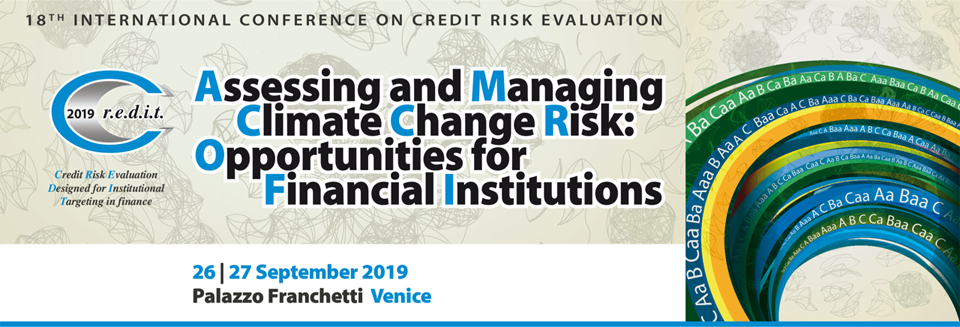
EAERE President Carlo Carraro will open the CREDIT2019 Conference and chair the Climate Risk And Equity Markets Session on September 26. He will also take part in the Panel Session Practice “Climate Change Risk: A Practitioners’ View” on September 27.

Renewables 2019 Global Status Report
REN21 is an international policy network of experts from governments, inter-governmental organisations, industry associations, NGOs, and science and academia. Every year, REN21 produces its annual flagship publication, the Renewables Global Status Report (GSR). According to the evidence of 2018, solar photovoltaics (PV) and wind are becoming increasingly popular in the power sector, with an increasing number of countries generating more than 20% of their electricity with solar PV and wind. However, current trends show that stronger policy decisions are needed across all sectors of energy end-use to make our energy systems sustainable. Data in this year’s report illustrate that ambitious policy and regulatory frameworks are needed to create favourable and competitive conditions, allowing renewable energy to grow and displace more expensive and carbon-emitting fuels.
Read the Full Report

New Report: Driving finance today for the climate resilient society of tomorrow
UNEP – Finance Initiative partnered with Climate Finance Advisors to deliver this report to the Global Commission on Adaptation as a contribution to a series of technical background papers on finance for adaptation and resilience supporting the GCA’s inaugural flagship report scheduled for September 2019. The report identifies the main barriers in the financial system to accelerated investment in adaptation-related programmes and projects and proposes six sets of recommendations to unlock the financing of adaptation programmes.
“Climate change is already affecting our economy, our society and our environment and these material impacts will continue to increase even if we manage to hit mitigation targets. It is therefore of paramount importance that adaptation to climate change is considered as important as reducing carbon emissions”.
Read the Full Report

Women’s Digital Financial Inclusion in Africa
|Source: Bill and Melinda Gates Foundation|
African governments are at the forefront of efforts to harness digital technologies to build more inclusive economies. Double-digit growth in mobile phone ownership in the first half of this decade has triggered a surge of innovative digital tools and services across the continent. However, the benefits of the digital age are not being shared equally. Women—especially those living in poor and marginalized communities—are most likely to be on the wrong side of a persistent digital divide.
This year, the Group of Seven (G7) outlined an agenda to fight inequality. As part of this agenda, the G7 Partnership for Women’s Digital Financial Inclusion in Africa will support African governments, central banks, and financial institutions in their efforts to build more inclusive, sustainable, and responsible digital financial systems, ensuring that 400 million more African adults are financially included—nearly 60 percent of whom are women. Essential to efforts to expand digital financial inclusion to women in Africa are five pillars that fall into three categories: infrastructure, regulation, and planning.
Read online
7th Workshop on Economics of Low-Carbon Markets
Papers submission deadline: 30 August 2019

Economists’ Statement on Carbon Pricing
The Policy Outreach Committee (POC) of the EAERE prepared a statement on carbon pricing to be proposed for endorsement to the whole community of economists in Europe and worldwide.
It aims to convey the European perspective on carbon pricing and to draw the attention of policy-makers to its importance as a key instrument, even though not the only one, to achieve the future de-carbonization targets.
In a short but clear statement, economists underline that a price on polluting activities is a crucial and efficient way to reduce GHG emissions. Even though not the only instrument, if properly designed carbon pricing can induce large-scale emission reductions. A price on carbon prompts companies to invest in carbon-free solutions and to improve energy efficiency. It sends a powerful signal, steering economic actors towards a low-carbon future. It encourages technological innovation, large-scale infrastructure development, as well as the diffusion of carbon-efficient goods and services.
Read and sign the statement here!
Read the Press Release
Read the article on FT