Economy & carbon markets

WCEREA Webinar – The implications of the ongoing war in the Middle East for climate policy and the green transition

The World Council of Environmental and Resource Economists Associations – WCEREA in collaboration with the IAEE, is pleased to announce the webinar on “The implications of the ongoing war in the Middle East for climate policy and the green transition” to be held on September 25, 2026 at 15:00 – 16:30 CEST

The Webinar
The war in the Middle East that began in early 2026 has substantially disrupted global oil and gas markets, as closures of the Strait of Hormuz, through which a large share of the world’s traded oil and LNG passes, have reduced supply and raised energy prices. Yet the price response has so far been more muted than the scale of the disruption alone might suggest. The implications for climate policy and the green transition are not straightforward. Higher fossil fuel prices act much like an implicit carbon price, yet the policy response to energy price shocks has often been to cushion consumers in ways that work in the opposite direction. Energy security concerns may strengthen the case for reducing fossil fuel dependence, but they can also favor diversification within fossil supply, and a transition built on critical minerals brings its own dependencies. Meanwhile, a more con ict-ridden geopolitical environment may make international cooperation on climate harder to sustain, even as the need for coordinated action becomes more pressing.
Several questions follow. Why has the price response been so muted, and what does that suggest about how exposed today’s energy systems still are to fossil fuel supply shocks? Do crises of this kind accelerate the transition, or do the policy responses they provoke slow it down? And what do past episodes, such as earlier oil shocks or Europe’s diversi cation away from Russian gas after 2022, tell us about which e ects persist once the prices normalize? In this webinar, we gather distinguished scholars from several regions and elds to present their views on these pressing questions.

Invited speakers

Register here

READ MORE
Supported Events

12th FSR Annual Conference on the Economic Assessment of European Climate Policies

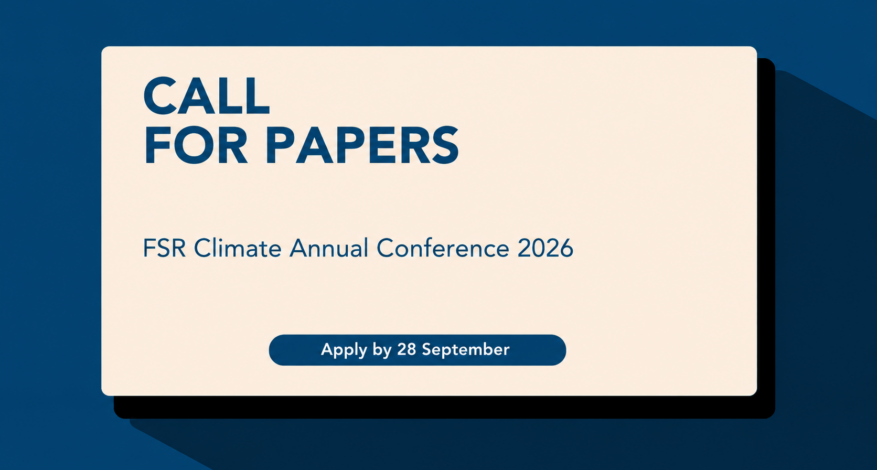
The Climate Area of the Florence School of Regulation (FSR) is pleased to announce its 12th Annual Conference on the Economic Assessment of European Climate Policies, taking place at the European University Institute in Florence from 30 November to 2 December 2026.

The Conference
The programme will bring together researchers working in the field, with academic sessions addressing key challenges in carbon pricing, emissions trading, environmental taxation, energy transition, energy efficiency, renewable energy, biodiversity and ecosystem services, among other topics. The event will feature paper presentations, guest lectures and plenary sessions.

Simone Borghesi , Director of the FSR Climate, Professor and Deputy Rector for International Relationships at the University of Siena and past EAERE President, will chair the conference.

Confirmed guest speakers are:

Estelle Cantillon, Université Libre de Bruxelles
Stefano Carattini, Georgia State University
Mireille Chiroleu-Assouline, Paris School of Economics
Philippe Delacote, INRAE and the Climate Economics Chair
Andreas Lange, University of Hamburg

Call for papers
The Conference Scientific Committee welcomes economic and interdisciplinary research contributions, particularly those advancing the understanding and evaluation of current and emerging climate policies at the EU, national and subnational levels, including:

• Carbon pricing, emissions trading, and environmental taxation;
• Energy transition, energy efficiency and renewable energy;
• Biodiversity and ecosystem services.

Presenting authors should submit a title, abstract and full paper in PDF format by Monday, 28 September 2026 (extended deadline). The Committee will evaluate submissions and communicate results by Sunday, 11 October 2026. Full details and the submission portal are available on the conference page.

Organisers
The Conference is organised by the Florence School of Regulation – Climate with the support of EAERE.

Important Dates
28 September 2026: Extended deadline for submissions
11 October 2026: Notification of acceptance
30 November – 2 December 2026: Conference dates

Further information
For further information, please contact FSRClimate@eui.eu  .

READ MORE
Supported Events

envecon 2027

The UK Network for Environmental Economists – UKNEE is glad to announce its next annual applied environmental economics conference, envecon,  to be held on March 5, 2027 at The Royal Society in London (UK).

Call for papers and posters

Let’s shift the narrative – nature is not a cost, it’s the foundation of economic success!
Governments and businesses focus on growth, jobs, and spending, but these goals depend on nature. The smart path to prosperity is recognising nature and climate as economic essentials, not afterthoughts.
We already know: nature has real economic value, early action on climate change and pollution is cost-effective, inaction carries rising costs for society.
But are we communicating that evidence effectively enough?
This year, we want to focus on showing how nature supports economic goals – so we are calling for papers, case studies, insights on:

  • Jobs – in nature-based sectors, directly dependent on nature, rewilding, busting the myth regulation kills jobs
  • Growth – how nature-positive policies and circular economy design can drive sustainable growth
  • Finance – public/private financial flows to nature, nature markets including carbon, biodiversity, nutrient, and international policy objectives for nature and development
  • Resilience – climate change and other systemic risks, early adaptation, balanced and innovation-friendly chemicals regulations
  • Agriculture – resolving the perception of nature vs food trade off
  • Marine / freshwater – boosting blue economy sectors while balancing trade-offs, paying for water to use and in the environment

Instructions for submissions

  • All papers should display academic rigour and show evidence of practical application.
  • Abstracts must not exceed 2 sides of A4, in 12-point font, double spaced – telling us about the approach, application, results and implications.
  • Please tell us the author for correspondence.
  • Please tell us if you will attend in person or online.

Deadline for submissions: November 16, 2026

Submissions are to be sent to uknee@uknee.org.uk.

More information

For more information, please contact uknee@uknee.org.uk.

READ MORE
Supported Events

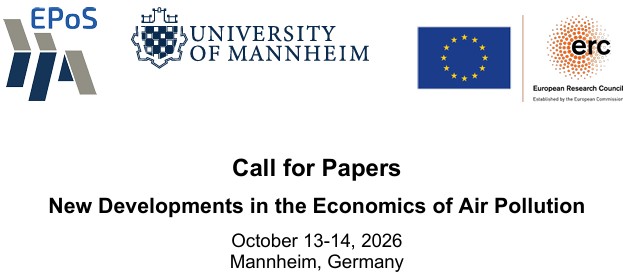
New Developments in the Economics of Air Pollution

Paper submissions are now open for the workshop New Developments in the Economics of Air Pollution, an EAERE-supported event taking place on 13–14 October 2026 in Mannheim, Germany.

The workshop will bring together leading scholars and promising early-career researchers to present and discuss cutting-edge research on the economics of air pollution. It offers an excellent opportunity to exchange ideas on innovative theoretical, empirical, and policy-oriented research addressing one of today’s most pressing environmental challenges.

We are pleased to announce the keynote speakers:
🎤 Erin Mansur (The Tuck School of Business at Dartmouth)
🎤 Shuang Zhang (Imperial Business School)
📅 Submission deadline: 29 July 2026

Accepted presenters will be notified by mid-August. Presenters and discussants will receive accommodation in Mannheim for up to three nights, a conference dinner, and may apply for limited need-based travel funding.

The workshop is organised by Ulrich Wagner (University of Mannheim), Julia Mink (The University of Bonn), and Kathrine von Graevenitz (University of Mannheim and ZEW – Leibniz Centre for European Economic Research), and is supported by the European Association of Environmental and Resource Economists (EAERE), the DFG Collaborative Research Center Transregio 224, the European Research Council (HEAL project), and the University of Mannheim.

🔗More information: https://lnkd.in/dDgWjESj

READ MORE
Events

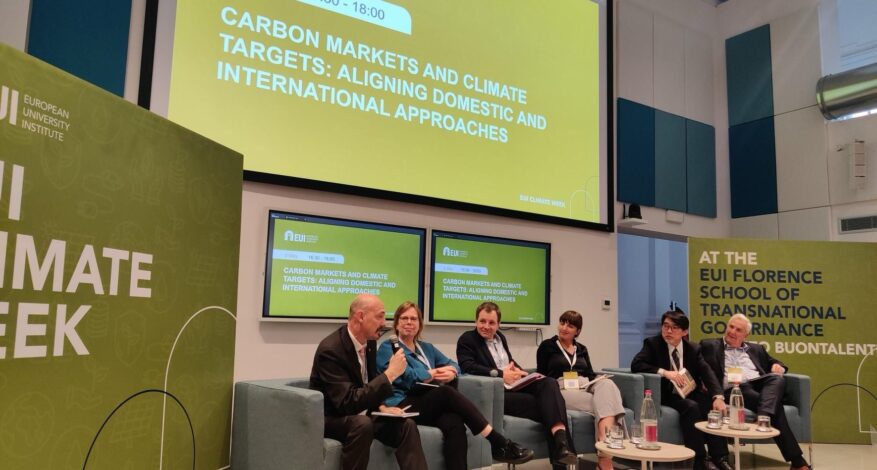
Carbon Markets and Climate Targets: Aligning Domestic and International Approaches

Chair: Simone Borghesi, European University Institute

Panelists:

  • Toshi Arimura, Waseda University
  • Carolyn Fischer, World Bank
  • Dirk Forrister, IETA
  • Ingy Johnstone, Oxford Net Zero
  • Sebastien Paquot, EU Commission

The session, organized by the Policy Outreach Committee, Co-organised with the Florence School of Regulation

Several jurisdictions like the European Union have decided to use international carbon credits as a complement to domestic mitigation efforts. Questions arise about their implications for cost-effectiveness, environmental integrity, climate justice and equity, and incentives for domestic emissions reductions. The policy dialogue is part of the EU-funded project LIFE NETS – Net-Zero Emissions Trading Schemes – which runs from 2026-2028.

READ MORE
Events

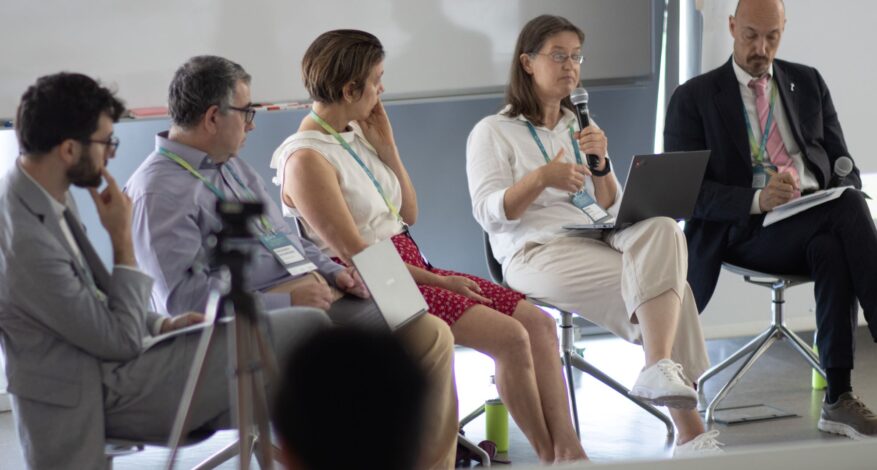
The IPCC 7th Assessment Report: new journey, new challenges

Chair: Simone Borghesi, European University Institute

Presenters:

  • Valentina Bosetti, Bocconi University
  • Fernando J. Díaz López, HEC Paris
  • Karen Pittel, ifo Institut
  • Theodoros Zachariadis, Cyprus Institute

The session, organized by the Policy Outreach Committee, will focus on the IPCC 7th Assessment Report.

Organiser(s): Simone Borghesi (University of Siena, European University Institute, EAERE president), Jacopo Cammeo (European University Institute)

The Seventh Assessment Report (AR7) of the Intergovernmental Panel on Climate Change (IPCC) marks the start of a new assessment cycle at a time of intensifying climate impacts and rising expectations for effective climate action. As this process unfolds, the IPCC faces the challenge of keeping climate science policy-relevant and decision-oriented while responding to evolving societal needs, without compromising its core principles of scientific rigor and neutrality in an increasingly complex global context.

The proposed session, “The IPCC 7th Assessment Report: new journey, new challenges”, aims to discuss the evolving role of the IPCC in this rapidly changing scientific, political, and economic landscape. The session will focus on key innovations and challenges of the IPCC AR7 cycle,including advances in climate science, the integration of interdisciplinary knowledge, science–policy interactions, and the implications of the AR7 process for policymaking and private-sector decisionmaking.

READ MORE