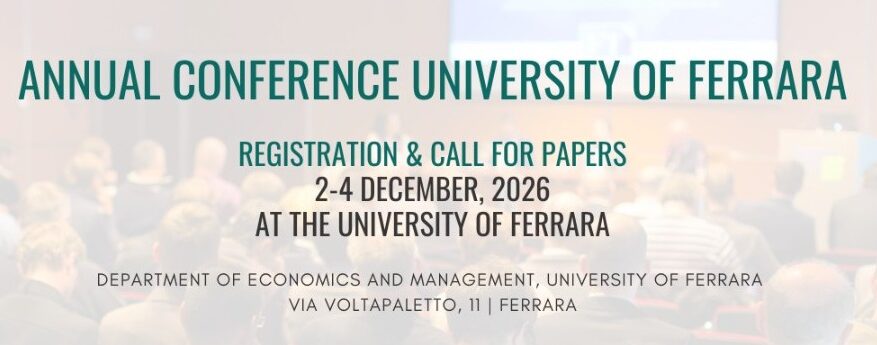
SEEDS Annual Conference 2026
The SEEDS Annual Conference 2026 will take place from 2–4 December 2026 at the University of Ferrara (Italy), hosted by the Department of Economics and Management. Organised in conjunction with the Horizon Europe project BioFairNet and supported by EAERE, the conference will explore how Circular Economy and Bioeconomy approaches can contribute to tackling climate change and supporting the EU’s sustainability transition.
The Conference
Conference Themes
Topics of interest include:
- Renewable energy generation and their impacts on climate change
- Waste management practices, materials waste prevention, reuse, recycling, energy recovery, disposal and their climate-related impacts
- The bioeconomy and the substitution of non-renewable materials with renewable ones, and its potential within the climate change discourse
- Promoting efficiency and cooperation within production chains, associated to climate change mitigations
- Promoting sharing and durability of goods, associated to climate change mitigation
The conference is open to any methodological approaches, including qualitative, quantitative, and mixed methods.
Pre-Conference Activities – 2 December 2026
The conference will include two simultaneous pre-conference workshops:
Workshop for Early and Emerging Scholars
This workshop welcomes early-career researchers including PhD candidates, postdoctoral fellows, and young academics working on sustainability, environmental economics, and circular economy. The aim is to receive feedback from peers and senior researchers and foster interdisciplinary dialogue on emerging topics related to the green transition, sustainable innovation, and environmental policy.
This workshop welcomes researchers and experts working at the intersection of engineering design, artificial intelligence, and circular economy. Topics include engineering design for sustainability and circular economy, generative design and topology optimisation, advanced and green manufacturing, digital twins, simulation-driven sustainability assessment, and AI for process optimisation and resource efficiency.
An informal Networking Aperitif will also take place on 2 December 2026 (18:30–20:30), bringing together stakeholders across research, industry, policy, and civil society working on circular economy and bioeconomy themes. Participants are encouraged to bring materials such as roll-ups, flyers, and project information to showcase their work and connect with the BioFairNet community.
Important Dates
- Submission deadline for all: 25 June 2026
- Acceptance confirmation: 21 July 2026
Registration & Submission Information Main Conference & Early and Emerging Scholars Workshop
Call for Papers
Researchers wishing to attend the conference, submit an abstract, or participate in the Early and Emerging Scholars Workshop should use the following form. The form is also open to non-presenting participants.
Conference Registration & Abstract Submission Form
Engineering Design & AI in Circular Economy Workshop
Researchers wishing to attend or submit an abstract specifically for the Engineering Design and AI workshop should register through the dedicated form below.
Engineering Design & AI Workshop Registration Form
Networking Aperitif Registration
Participants interested in attending the Networking Aperitif should complete the separate registration form below. Attendance at the aperitif does not automatically confirm participation in the conference.
Networking Aperitif Registration Form
Participation & Logistics
Participation in the conference is free of charge. Coffee breaks and lunch will be offered to participants who confirm their presence. Participants will need to cover their own expenses for travel, accommodation, and meals outside conference activities.
All conference activities will be held at the University of Ferrara, Department of Economics and Management, Via Voltapaletto 11, Ferrara, Italy. Ferrara can be reached by train, car, or plane via Bologna Airport, with connections available through train services and shuttle transport.
The organisers also promote environmentally responsible conference practices, including recycling facilities, water refill stations, and vegetarian catering provided by a social cooperative.
More information here