Conference: Environmental Sustainability and the ‘European Green Deal’: Values, Innovation and Regulation
POSTPONED TO 12 NOVEMBER 2020
For information and registration write to: alberto.defranceschi@unife.it
This conference will be also the kick-off meeting of the newly established European Law Institute’s Environmental Law Special Interest Group.
1st Biennial Conference of the African Association of Environmental and Resource Economists (AFAERE)
Deadline for paper submissions:15 April 2020
2nd Edition of the PhD Summer School on “Economic Foundations for Energy and Climate Policies”
After the great success of the first edition, Universidad Carlos III, DIW Berlin, EUI-Florence School of Regulation, Technical University Berlin, Universidad Autónoma de Madrid, University College London and Université Libre de Bruxelles are happy to announce the second edition of the PhD Summer School on “Economic Foundations for Energy and Climate Policies”.
The Summer School will be held on September 7-11, 2020 at Universidad Carlos III de Madrid (Downtown campus). Application deadline is 30th April 2020.
Objectives
The main objective of the School is to provide Economics PhD students with high-level academic training on the micro-economic foundations of energy and climate policy instruments. The School is also aimed at supporting the development of a PhD-student network for students interested in the topic, and connect them with top academics in the field.
Instructors and topics
– Stefan Ambec (Toulouse School of Economics): “’The Challenges of Intermittent Renewables’”
– Estelle Cantillon (Université Libre de Bruxelles): “Design and Development of the EU ETS”
– Xavier Labandeira (Universidade de Vigo): “A Primer on Environmental Taxes and Green Tax Reforms”
– Juan Pablo Montero (Pontificia Universidad Católica de Chile): “Environmental Regulation and the Transport Sector”, and “The Design of Environmental Instruments”
Please apply through THIS LINK and send the mandatory documents to energyecolab@gmail.com (subject: 2020 Summer School). For any questions please contact Laura García Llamas (Universidad Carlos III) at lgllamas@pa.uc3m.es
For more information, check out the University Carlos III de Madrid‘s website regularly

COVID-19, global climate policy and carbon markets: expected impacts and possible solutions
The COVID-19 pandemic is having a dramatic impact on economic activities worldwide. This has both direct and indirect effects on greenhouse gas emissions and global warming. On the one hand, the fall in production and traffic volumes drastically reduces emissions, as it has already been observed after a few weeks of lockdown in a growing number of countries. On the other hand, the deep economic recession which might affect the world economy in the next years is likely to slow down the technological progress that is needed to progress along a low-carbon economic path. Moreover, the economic depression obviously has a large impact also on carbon markets: the fall in production brings about a sharp decrease in the demand of emission allowances, which causes a reduction in the allowance prices and thus also -ceteris paribus- in the incentive to invest in clean technologies.
For these reasons, it appears particularly important to identify in advance a suitable economic-climate package which may relaunch clean investments when economic activities will resume and avoid that the economic downturn may be followed by a sharp growth in emissions when the pandemic will be gone.
This raises some of the questions that we would like to address in this online debate, namely:
- What economic and climate policy package will be needed to deal with the economic consequences of COVID-19?
- How will the current emergency affect the European Green Deal?
- What consequences the ongoing pandemic may have on the EU ETS? What are its expected effects on the other Emission Trading Systems worldwide?
- What impact COVID-19 might have on international cooperation among Emission Trading Systems?
- What lessons can be learnt from the current pandemic for cooperation among countries in the international climate policy?
FSR Climate, in collaboration with the Policy Outreach Committee of EAERE (European Association of Environmental and Resource Economists), organises this online event to promote a more integrated dialogue between academia and policy world, providing advice and support to EU policy makers and institutions in designing policy interventions, which is particularly needed and urgent in these difficult times.
The event builds upon the successful experience of policy debates organized by FSR Climate at State of the Union since 2018 and intends to continue the policy dialogue carried out by FSR Climate under the ongoing LIFE DICET (Deepening International Cooperation on Emissions Trading) project. The project, co-funded by the LIFE Programme of the European Union, focuses on the international carbon market cooperation between the EC and the regulators of other major Emission Trading Systems, namely, California-Quebec, China, Switzerland and New Zealand and intends to support EU and Member State policymakers in deepening international cooperation for the development and possible integration of carbon markets at the world level.
Format
Short presentations from the invited speakers followed by questions from the audience.
Chair
Simone Borghesi, Director, FSR Climate, EUI
Jos Delbeke, School of Transnational Governance, EUI
Invited speakers
Christian Gollier, Director of Toulouse School of Economics, President European Association of Environmental and Resource Economists
Phoebe Koundouri, Professor, School of Economics, Athens University of Economics and Business; President-Elect EAERE; Chair, UN SDSN Greece; Director EIT Climate KIC Hub Greece; Chair ICRE8
Eswaran Somanathan, Economics and Planning Unit of the Indian Statistical Institute, Delhi, India, and Program Director of CECFEE (Centre for research on the Economics of Climate, Food, Energy and Environment)
Harald Winkler, University of Cape Town and Academy of Science of South Africa
WATCH the video here
Data for Policy Conference 2020 – Special Track
Special Track 7: Harnessing Data and Science to Achieve the Sustainable Development Goals
Papers submission deadline: April 20, 2020
Website
Third GREEN-Econ Spring School in Environmental Economics
Call for papers deadline: April 10, 2020
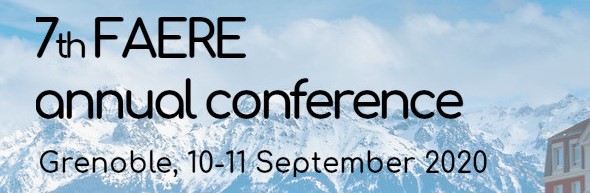
7th Annual Conference of the French Association of Environmental and Resource Economists (FAERE)
Papers submission deadline:17 April 2020